In this guide
The request is honest and a little impatient: write a book for me. Nobody asking it wants to be told that books take a year. They want the thing they have been meaning to write to exist.
That part is now possible. A first draft of a 20,000-word guide is a few focused days, not a lost quarter. What the request hides is that "write a book" is not one job, and only some of the jobs can be handed over.
"Write a book for me" is five jobs
| Job | What it means | Can a tool do it? |
|---|---|---|
| Structure | Decide the type, the unit, the length, the order | Yes, and it is better at this than most people |
| Draft | Produce a readable chapter that follows the plan | Yes, with facts and a plan to obey |
| Material | Supply the cases, numbers, interviews and failures | No. This is the book |
| Judgment | Decide what the book claims and what it refuses to claim | No. This is the author |
| Publishing | Export a file, fill the metadata, disclose AI use where asked | Mostly, and it removes the fiddly part |
Most disappointment with AI books comes from asking the tool for columns three and four, getting a competent version of columns one and two, and concluding the tool failed. It did the job it could do. The missing half was never in the prompt.
What a generator does well
Be specific about this, because the honest list is longer than skeptics admit:
- Structure. A guide that teaches one skill in the order a reader hits the problems. A workbook whose exercises build. A devotional where every entry has the same shape. This is pattern work, and models are good at pattern work.
- A first draft that moves. Chapters that open with a claim, explain it, give an example, and end with an action. The rhythm of a useful nonfiction chapter is learnable.
- Rewriting to a constraint. "Cut this to 900 words and remove every adjective that is not backed by a number" is a request a model handles well.
- The unglamorous parts. Front matter, back matter, chapter titles, a description, keyword variants, an about-the-author page.
- Coverage you would miss. Ask for the ten objections a reader will have, and use the list to check your plan. You will keep six and delete four.
What only you can supply
The draft gets better or worse on four things, and none of them are in the model:
- Specifics. The client who paid late, the number you charged, the week the plan failed. A book about pricing that never names a price is an essay.
- A position. "It depends" is not a chapter. Your book should be wrong about something, in a way a reasonable reader could argue with.
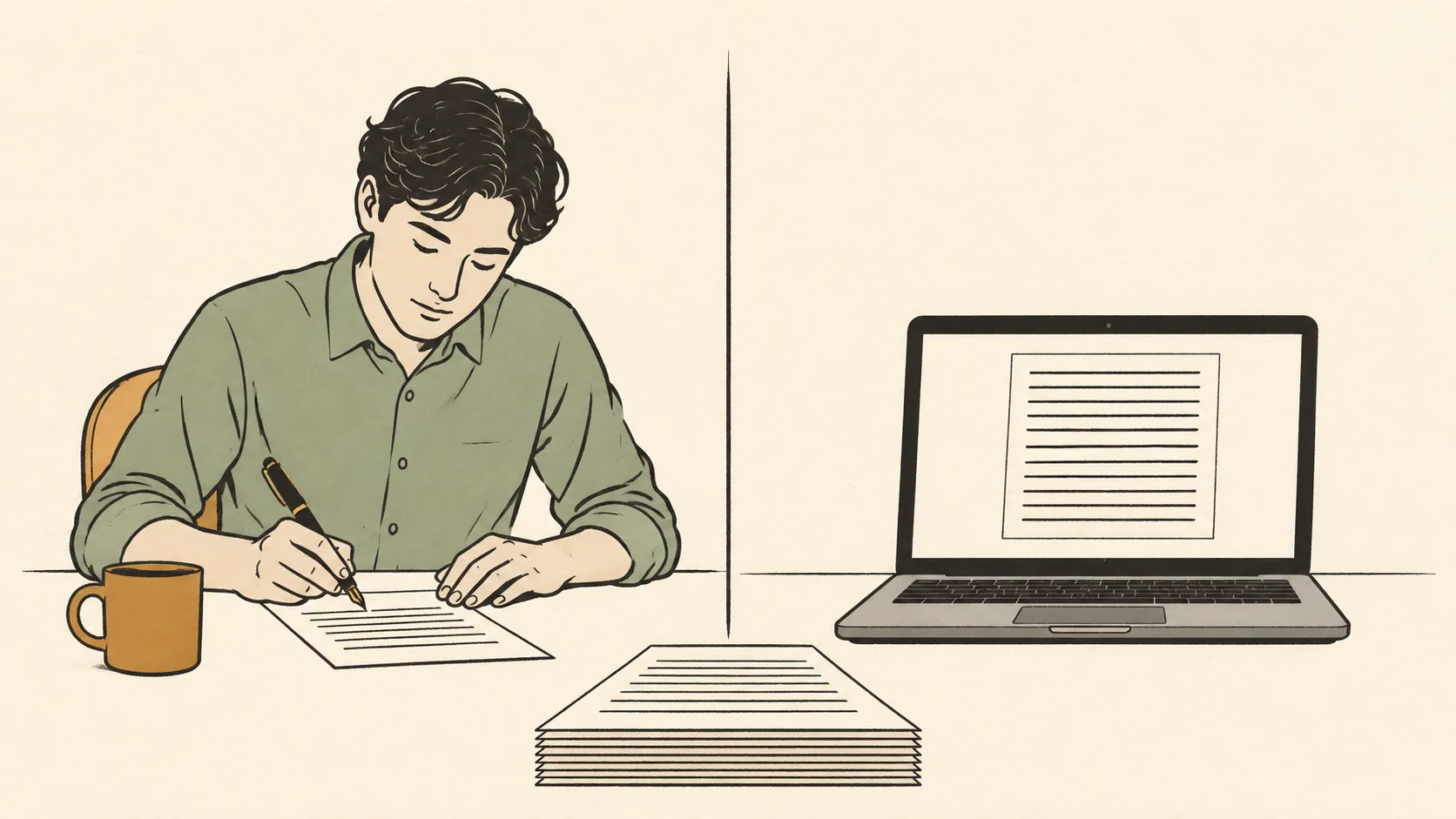
- Taste. Which example to keep, which sentence is too clever, when the book should stop. This is the part readers experience as voice.
- Responsibility. If the book says a contract clause is safe, someone may rely on it. A model will produce the sentence. Only you can decide whether it should exist.
The handoff that works
The split is easiest to see as a sequence, with a clear owner for each step.
You write the premise. One paragraph: the reader, the outcome, the constraint, where the material comes from. Twenty minutes, and it decides the book.
You add the facts. In the book's Global knowledge panel, write the five to fifteen things that must be true throughout: the numbers, the rules, the reader's situation, the mistake you are correcting. This is the step people skip, and it is the step that makes the draft yours.
The tool plans. Generate the chapter plan and read it as an editor. Delete the chapter that exists because books like this have one. Rewrite the goals so each chapter produces a change, not a topic.
The tool drafts, one chapter at a time. Read each chapter before the next. You are not polishing; you are checking whether it still agrees with the facts and whether it has started to repeat itself.
You add what is missing. After the draft exists, go back through it with one job: in every chapter, add one thing only you could have written. A number, a name, a mistake, an opinion.
You edit for voice. Read the book aloud. Cut the sentences you would not say. The first page gets the most attention, because it is the page a store shows for free.
The books this fits best
The workflow suits books bought for an outcome, which is most of the market that is not fiction:
- A lead magnet, 4,000 words. Five to eight short sections, one promise, given away to collect emails. The draft is quick; the value is in the offer at the end.
- A workbook, 12,000 words. Exercises with instructions and space to write. The structure is the product, and structure is what a tool is best at.
- A how-to guide, 20,000 words. One skill, start to finish. This is the strongest fit: it needs a clear order, concrete steps, and at least a dozen specifics from your own work.
- A memoir, 30,000 words. Your story told as a lesson. The tool can hold the episodes and the timeline, but every scene has to come from you, or the book has no reason to exist.
Fiction is the exception. A novel needs a spine of promises and a prose line that readers judge on the first page, and the tool's contribution is smaller. It can draft, and it can keep continuity. It cannot make the sentences yours.
What to do in week one with a draft
Do not start by editing sentences. Start by deciding what the book is.
- Read the whole draft in one sitting, on a phone if you can. Note the chapter where you get bored. That chapter is the problem.
- Delete one chapter. Most first drafts have one that exists to be complete. The book is usually better without it.
- Add ten specifics across the book: numbers, names, dates, costs, failures.
- Mark every claim you are not sure about. Check them, soften them, or cut them.
- Rewrite the first page by hand. Then read it aloud twice.
That week is the difference between a generated manuscript and a book with your name on it.
Disclosure and ownership, plainly
Amazon KDP asks during publishing whether AI-generated content was used, and the answer does not block publication. Answer honestly; the disclosure is not the thing that loses readers.
Ownership is a separate question, and it depends on the tool's terms. Read them once, before you write, and know whether you own the output, whether your inputs are used for training, and what happens if you leave. Our own terms are on the site, and they are worth five minutes.
What no terms can give you is authorship in the sense readers mean it. That comes from the material and the judgment, which is the part you kept.
The bottom line
If you want to write a book for me, the honest version of the request is: draft my book, hold its structure, and get out of the way while I put myself into it. A tool can do the first two. The third is not a limitation of the software. It is what makes the book worth reading.
Before you call the draft a book
- The premise names a reader and an outcome, not a topic.
- Every chapter has at least one fact that came from your own work.
- The book takes a position a reasonable reader could argue with.
- You have deleted the chapter that existed for completeness.
- The first page has been rewritten by hand and read aloud.
- AI use is disclosed wherever the store asks.
Frequently asked questions
Can AI write a whole book for me?
It can write the draft: chapters, structure, pacing, front matter. It cannot supply the material that makes the book worth reading, and it cannot take responsibility for the claims. The draft is the part you can outsource. The book is not.
How much editing does an AI draft need?
Plan on one full read for structure and one for voice, then a line pass. The structural read is the important one: delete a chapter, reorder two, and add the specifics that only you know. A draft that skips that pass reads like every other book on the subject.
Will readers know the book was written with AI?
Some will guess, and you should disclose where the store asks. What readers actually judge is whether the book gives them something they could not get elsewhere. A disclosed, specific book sells. An undisclosed, generic one does not.
Sources
- Google Search Central — Creating helpful, reliable, people-first content — read on 2026-11-17
About the author

One useful essay, every other week
Notes on writing, publishing, and the unglamorous parts of shipping software. No roundups, no growth hacks.