In this guide
- A book is a project, not a prompt
- The seven moves, in order
- Move one: pick the structure before the prose
- Move two: write a premise that can be checked
- Move three: put your experience into facts
- Move four: generate the plan, then edit it
- Move five: write one chapter at a time
- Move six: read at chapter ten, not at the end
- Move seven: export, then check the file
- What still makes a draft slop
- The bottom line
You can write a book with AI. That sentence is not the hard part, and neither is choosing a model. The hard part is that most people start with a blank chat box, ask for a book, get something that sounds like a book, and only discover at chapter six that it has no spine.
The difference between a manuscript and a pile of chapters is state: the structure, the facts, the plan, and the record of what has already been said. A chat window holds that state for one conversation. A book needs it for six weeks.
A book is a project, not a prompt
Ask a model for "a book about freelance pricing" and it will produce a table of contents that looks plausible. Every chapter title will be balanced. Every promise will be generic. Nothing in it could only have come from you.
That is not a model failure. You asked for the average of every book on the subject, and you got it.
A project looks different. It has a type with a fixed unit (chapters, exercises, recipes, entries), a premise with a reader and an outcome, a facts panel that the model is not allowed to contradict, a chapter plan you can edit, and an export that turns the whole thing into a file a store accepts. The prose is the last thing that happens, not the first.
The seven moves, in order
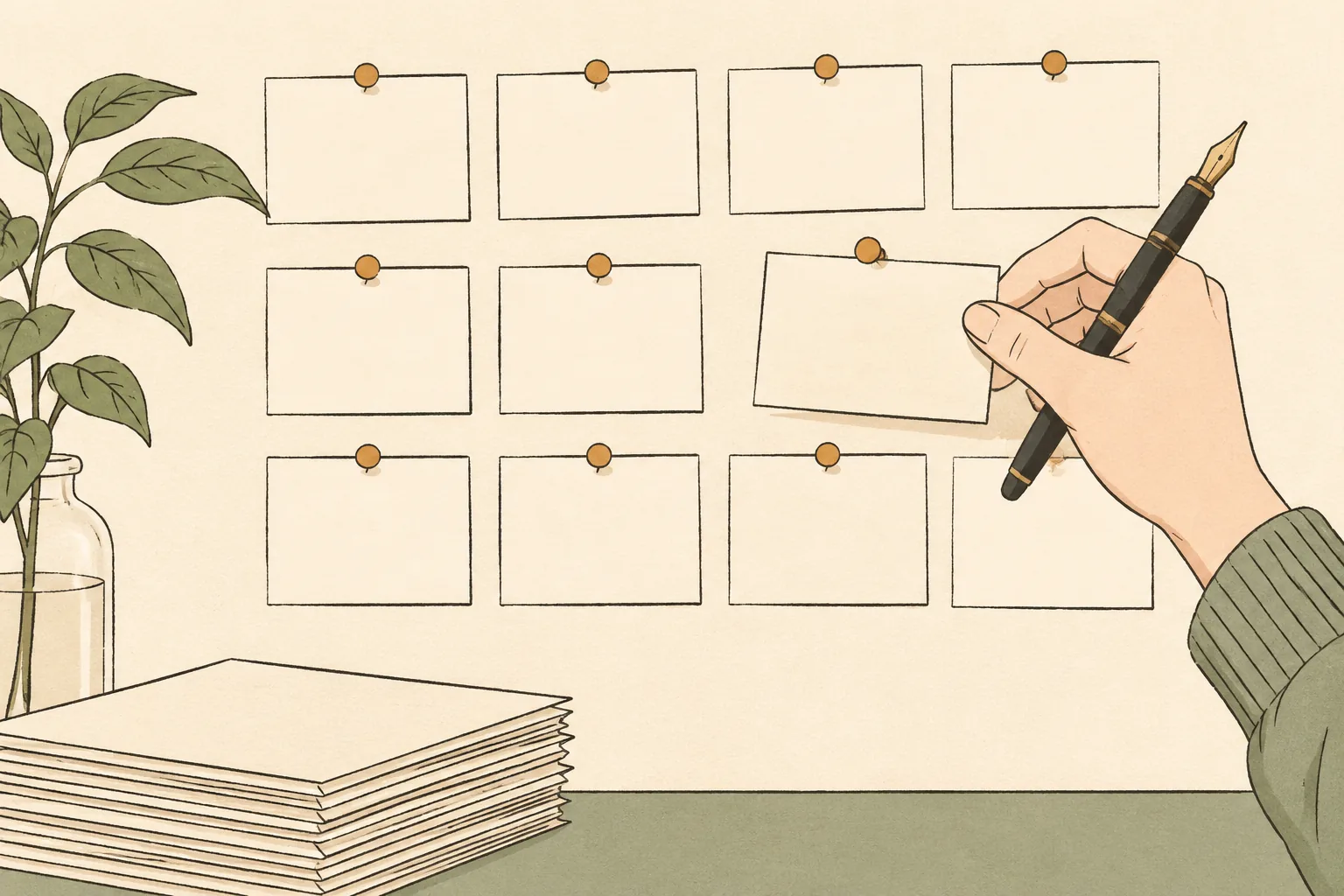
The order matters, because each move gives the next one something to stand on.
| Move | What you produce | What it prevents |
|---|---|---|
| 1 | A book type with a unit and a target length | A structure that does not fit how you sell it |
| 2 | A premise with a reader and a checkable outcome | A book about everything, for everyone |
| 3 | Facts from your own experience | Generic advice and contradictions |
| 4 | An editable chapter plan | Discovering the book has no spine at chapter 6 |
| 5 | One drafted chapter at a time, read before the next | Drift and repeated material |
| 6 | A mid-book read at chapter ten | Finding structural problems after 30,000 words |
| 7 | A real export file | Formatting surprises at upload |
Move one: pick the structure before the prose
The type decides what a unit is called and how long the whole thing runs. A how-to guide defaults to 20,000 words in chapters. A workbook defaults to 12,000 in exercises. A devotional runs 9,000 as dated entries. A lead magnet is 4,000 across five to eight short sections. A memoir is 30,000. Fiction defaults to 70,000.
This matters more than it sounds. A 12,000-word workbook and a 70,000-word novel need different chapter plans, different amounts of preamble, and different definitions of "finished". Choosing the type first means the plan arrives already shaped for the thing you intend to sell.
If you are unsure, ask what the reader will do with the book. Work through it, write in it, read one page a day, cook from it, or finish it on a plane. The answer picks the type.
Move two: write a premise that can be checked
Most premises are moods. "A practical guide to freelancing for creative people" cannot be wrong, which means it cannot be right either. A model given that premise has nothing to obey.
A checkable premise names four things:
- The reader, specifically enough that you can picture one. Not "freelancers" but "designers in their second year who have one anchor client and no process for pricing the next one".
- The outcome, in observable terms. Not "feel confident" but "quote a fixed price in a fifteen-minute call without discounting".
- The constraint, the thing your book refuses to do. "No hourly rates, no retainer templates, no advice that assumes a sales background."
- The evidence, where the material comes from. "Three years of quotes, twelve client calls, and the two deals I lost by undercharging."
Write it as one paragraph in the book's premise field. Then test it: could any other book have this exact premise? If yes, it is still a mood.
Move three: put your experience into facts
This is where an AI book stops being generic. Before drafting anything, open the book's Global knowledge panel and add the facts the model must not contradict.
Facts are label-and-value pairs, and they get injected into every chapter prompt. The panel keeps three things separate:
- Facts. The people, numbers, rules and opinions that are true in this book. "Anchor client: one retainer at $4,200 a month." "My rule: never quote on the first call." "Reader's mistake: pricing the deliverable instead of the outcome."
- Already covered. Topics the book has explained, so later chapters stop re-teaching them. The panel fills this in as chapters are written, and you can add your own.
- Voice and structure. Rules about how the book sounds. "First person. Short sentences. No exclamation marks. Every chapter ends with one action the reader can take today."
A fact has to be specific enough to disagree with. "Be confident" is not a fact. "I raised prices 18% in year two and lost four clients out of thirty-one" is.
Move four: generate the plan, then edit it
A plan is where a book is cheap to fix. Editing one chapter costs a chapter. Editing one plan costs five minutes.
Generate the outline from the premise and the facts, and expect to rewrite it. The useful questions are:
- Does each chapter solve one problem, in the order the reader hits it?
- Does any chapter exist only because a book like this usually has one?
- Can you name the single outcome of each chapter in one line?
- Is chapter one the thing the reader came for, or is it background?
Plans run from 3 to 60 units, and regenerating appends a new plan rather than overwriting the old one. That is deliberate: a writer who wants a different second half should not lose the first.
Move five: write one chapter at a time
Drafting is deliberately small. A chapter defaults to 1,200 words and can be set between 400 and 4,000. The model receives the premise, the type brief, the facts, the previous chapter's recap, and the tail of the chapter you are continuing. It does not receive the whole manuscript.
That is not a limitation to work around. It is the reason the book stays coherent: the recap carries what the previous chapter established, and the facts panel carries what must never change. Feeding 30,000 words into a prompt every time is how you get contradictions and a bill you cannot predict.
Two controls matter in practice. Steer is an optional instruction for one chapter only: "open with the failed quote, not with theory". Continue extends the scene you are looking at instead of starting a new draft, which is how you get past a chapter that stopped one paragraph too early.
Read every chapter before starting the next one. Not to polish it, just to notice when it has drifted, repeated a section, or explained something chapter three already covered.
Move six: read at chapter ten, not at the end
Ten chapters is roughly 12,000 words, which is a third of a guide and the point where structural problems become expensive. Read the first lines of every chapter in order. If they read like a table of contents narrated by one voice, the book is too even.
The chapter-ten read
- Read the first sentence of each chapter in order. Does the argument move or just announce topics?
- Search for the three facts you care most about. Does every chapter agree with them?
- Look for a chapter that could be deleted without loss. Delete it from the plan.
- Find one place where the book says something only you could say. If there is none, add one.
- Check the length of each chapter. Three identical lengths in a row means the plan is too symmetrical.
Move seven: export, then check the file
A draft is not a book until it leaves the editor. Export produces EPUB 3 for KDP, Apple Books and Kobo, DOCX for print interiors and further editing, and Markdown if you want the text in a repo. Front matter and back matter — title page, copyright, about the author — are toggles, and the author details print from what you enter.
Check the file before you upload it. Open the EPUB on a phone, jump through the table of contents, and read the first and last chapter on the small screen. Every year, books that read beautifully in an editor arrive at a store with a broken contents page.
The publish side has its own limits, and they differ by store. Amazon KDP allows seven keyword slots and three categories; the pack shows the limit for whichever platform you pick, so you are filling the right number of fields instead of guessing.
What still makes a draft slop
No process fixes a book with nothing in it. These are the signs that the problem is not the tool:
- Every example could belong to any book on the subject.
- Every claim is balanced, and the book never takes a side.
- There are no numbers, names, failures or costs.
- The draft has not been read end to end by a human.
- The book answers a question the reader could have searched in ten seconds.
An AI draft can carry structure, pacing and first-pass prose. It cannot supply your cases, your numbers, your opinion, or the accountability for being wrong. That part is still the job, and it is the part readers are paying for.
The bottom line
Learning how to write a book with AI is mostly learning what to give the model before it writes: a type, a checkable premise, your facts, and a plan you have edited. After that, the work is one chapter at a time, read as you go, exported to a file that opens cleanly on a phone.
The tool writes the draft. The book is still yours, and it shows.
Key takeaways
- 1A book needs state — structure, facts, plan, continuity — and a chat window only holds it for one session.
- 2Pick the type first: it sets the unit, the length and the shape of the plan.
- 3Put your real experience into facts the model cannot contradict. One specific fact beats ten adjectives.
- 4Draft one chapter at a time and read it before the next. That is where drift is caught.
- 5Export and open the file on a phone before you call the book finished.
Frequently asked questions
How long does a 20,000-word book take with AI?
A 20,000-word guide runs to about 17 chapters at the 1,200-word default. The free plan allows three AI drafts a day, so the drafting alone fits inside a week. Editing is the part that sets the real timeline.
Do I need to learn prompt engineering first?
No. You need a plan, a set of facts the book must not contradict, and the patience to read each chapter before the next one is written. Those three things do more than any prompt trick.
Can I sell an AI-assisted book on Amazon?
Yes. KDP asks you to disclose AI-generated content during publishing, and the disclosure does not block publication. What blocks sales is a book with no first-hand value, whatever produced it.
Sources
- Google Search Central — Creating helpful, reliable, people-first content — read on 2026-11-14
- Nielsen Norman Group — How Users Read on the Web — read on 2026-11-14
About the author

One useful essay, every other week
Notes on writing, publishing, and the unglamorous parts of shipping software. No roundups, no growth hacks.