In this guide
The phrase "AI ghostwriter" is doing two jobs at once, and that is where the confusion starts. Sometimes it means a person who uses AI to deliver a manuscript faster. Sometimes it means software you drive yourself.
The difference is not cosmetic. In the first case you are buying a service: someone interviews you, writes, revises, and is accountable for the result. In the second you are buying a tool and doing the managing. Both are legitimate. They cost different amounts because they remove different work.
What a ghostwriter actually sells
Strip away the mystique and a good ghostwriter sells four things:
- Time. They write while you run your business. That is the headline.
- Judgment. What to include, what to cut, which anecdote carries the chapter. This is craft, and it is why rates vary so much.
- Access to you, structured. A good ghost interviews you. The interview is where the book's specifics come from, and it is work you cannot skip.
- Accountability. If a chapter is wrong, there is a person who fixes it. That is worth real money when your name is on the cover.
Most manuscripts are quoted per thousand words, and the total for a full book plus editing usually lands in the thousands, not the hundreds. The number that matters is not the rate. It is the total for a finished, edited manuscript, and the time you spend being interviewed.
What an AI ghostwriter actually is
Software. You choose the type, write the premise, enter the facts, edit the plan, and press write. The model drafts; you read every chapter; you decide what stays.
That means the four things above change hands:
| What a ghostwriter sells | With AI |
|---|---|
| Time | Partly. Drafting is fast; reading and editing are yours |
| Judgment | No. You are the editor-in-chief now |
| Structured interviews | No. You write the facts yourself, or record yourself and upload the transcript |
| Accountability | No. The book is yours, including the mistakes |
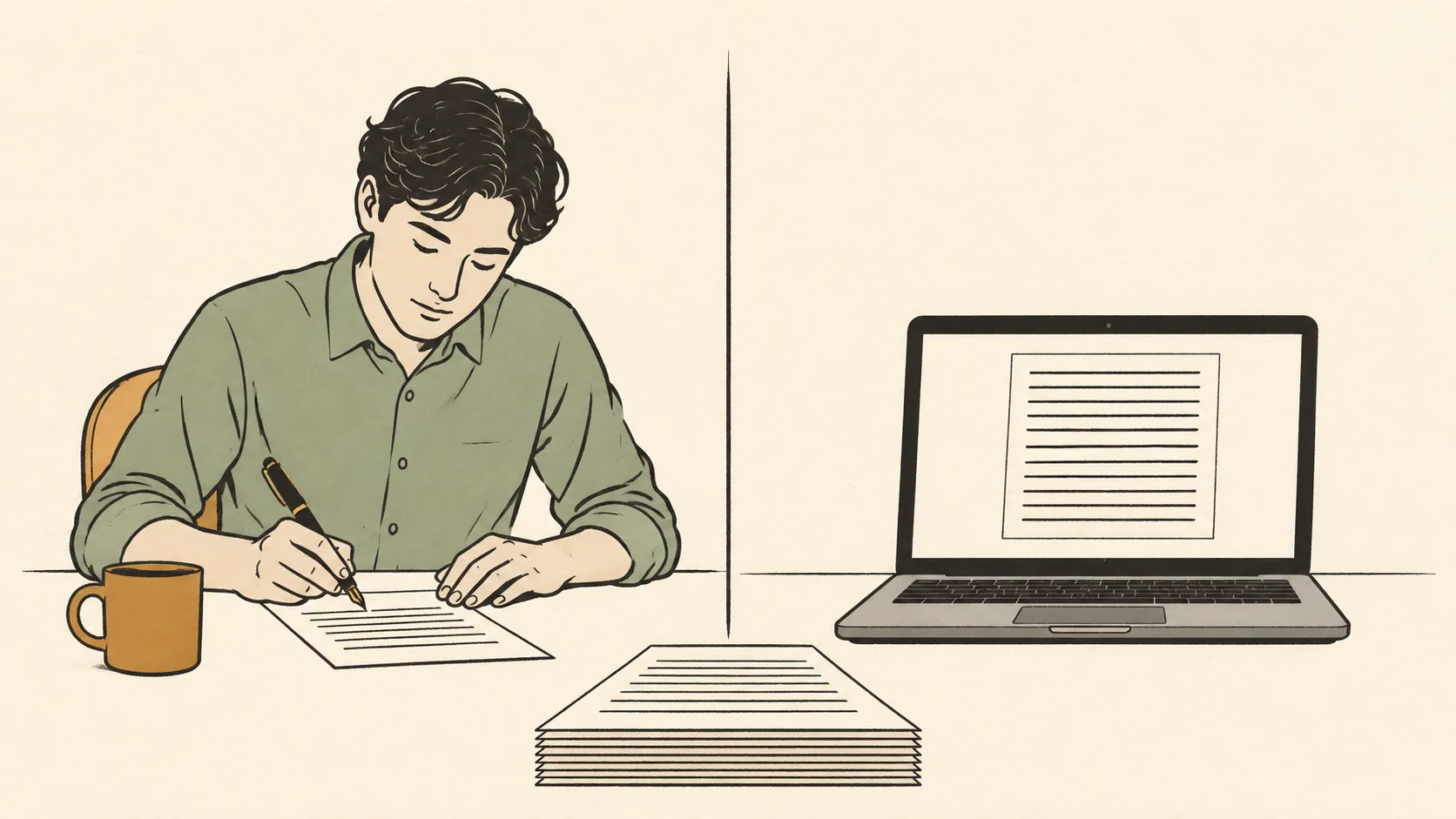
None of that makes the AI route worse. It makes it a different purchase. You are trading money for your own attention, and the trade is good if your attention is the cheaper of the two.
The cost comparison, done honestly
The AI route is not free, and it is not only the subscription.
Cash. A 20,000-word guide is about 17 chapters at 1,200 words. On our free plan that is three chapters a day; Plus at $8.49 a month covers roughly 660 chapters, so the software cost for one book is close to nothing. A human ghostwriter for the same book costs orders of magnitude more, and that gap is not going to close.
Your time. Drafting 17 chapters takes hours. Reading and editing them takes days. Adding the specifics, rewriting the first page and checking claims takes another week. If your hourly rate is high, do that arithmetic before you assume AI is cheaper.
Editing. This is the line item people forget. A human ghostwriter's quote usually includes revisions. An AI draft arrives needing a developmental pass: one read for structure, one for voice, one for facts. You either do it or pay an editor, and a good editor is not cheap.
Put together, the honest comparison is not "AI versus ghostwriter". It is "drafting cost versus editing cost". AI removes most of the first and none of the second.
Where AI actually wins
- Structure. Chapters that each do one job, in the order a reader needs them. This is the part most first-time authors struggle with, and it is cheap to generate and cheap to fix in a plan.
- Speed to a readable draft. You can see the shape of the book in a week instead of a quarter, which matters when the decision is whether to write it at all.
- Consistency. Facts injected into every chapter mean the book does not contradict itself at chapter twelve.
- Revision at chapter level. Rewriting one chapter does not mean renegotiating a contract.
- Cost you can forecast. Chapters are countable. A quote is not.
A hybrid that works
The best value is usually three roles, not two:
- You, interviewed. Record twenty questions about the book: the reader, the outcome, the five stories only you can tell, the mistakes, the numbers. Transcribe it.
- The tool, drafting. Mount the transcript as a source, put the binding facts in the knowledge panel, plan 17 chapters, draft them one at a time.
- A human editor, on the first three chapters. Not a proofread. A developmental edit of the opening, which is the part that decides whether anyone reads chapter four.
Then rewrite the rest yourself, with the editor's notes as a model. You get the ghostwriter's judgment where it matters most, at a fraction of the cost of a full manuscript.
Credit, ownership and disclosure
Three separate questions, often blurred into one.
Credit. A human ghostwriter usually works under a contract that assigns copyright to you and may or may not require credit. Read the contract. The default in publishing is that the named author is the author.
Ownership of AI output. This depends on the tool's terms, not on copyright law alone. Know whether you own the output, whether your inputs train anything, and what happens to your manuscript if you cancel. Ours are on the site; read any tool's before you write 40 chapters.
Disclosure. Amazon KDP asks during publishing whether AI-generated content was used, and answering yes does not block publication. Some authors disclose in the front matter; some do not beyond the store's form. If the book's value comes from your experience, disclosure costs you very little and protects the thing that matters: reader trust.
Who should pick which
- Choose a human ghostwriter if you have budget, no time, and material that lives in your head and needs to be interviewed out of you.
- Choose AI if you have the material, the time to edit, and a book that is short and outcome-driven: a guide, a workbook, a lead magnet.
- Choose the hybrid if you want a sellable book and can afford one editor's pass. It is the best value for most first books.
What does not work is buying the AI route and expecting the ghostwriter's job to happen anyway. Nobody is going to interview you, notice that chapter seven is weak, or take responsibility for a claim. That is the part you kept when you chose the software.
The bottom line
The AI ghostwriter is not a cheaper ghostwriter. It is a different deal: you trade cash for your own judgment and time, and you keep the accountability. Decide which of those you can afford before you start, and the choice between a human, a tool and a hybrid becomes much less emotional.
Key takeaways
- 1A ghostwriter sells time, judgment, structured interviews and accountability — AI only removes the drafting.
- 2Compare editing cost, not drafting cost: the second is where both routes spend real money.
- 3Keep the interview. A recorded Q&A uploaded as a source is what makes an AI draft specific.
- 4Disclose AI use where the store asks; a useful book survives it and a generic one does not.
- 5The hybrid — you interview, AI drafts, an editor fixes the opening — is the best value for most first books.
Frequently asked questions
Is an AI ghostwriter cheaper than a human one?
Yes, by a wide margin, because you are not paying for a person’s time. You are paying for software and supplying the judgment yourself. The saving is real, and so is the work that moves back onto your desk.
Do I have to disclose that AI wrote my book?
Amazon KDP asks during publishing whether AI-generated content was used, and disclosure does not block publication. Beyond the store’s rules, disclosure is an editorial choice: a specific, useful book survives it, and a generic one does not.
Can a ghostwriter fix an AI draft?
Many now do, and it is often the cheapest route to a good book. Budget for a developmental pass, not a proofread. The draft’s structure is usually the part that needs the most work.
Sources
- Google Search Central — Creating helpful, reliable, people-first content — read on 2026-11-18
About the author

One useful essay, every other week
Notes on writing, publishing, and the unglamorous parts of shipping software. No roundups, no growth hacks.