
How to keep the same face across AI images (and when it still fails)
A practical workflow for consistent character generation — how reference-based identity works, what breaks it, and the prompt habits that keep a face stable across scenes.
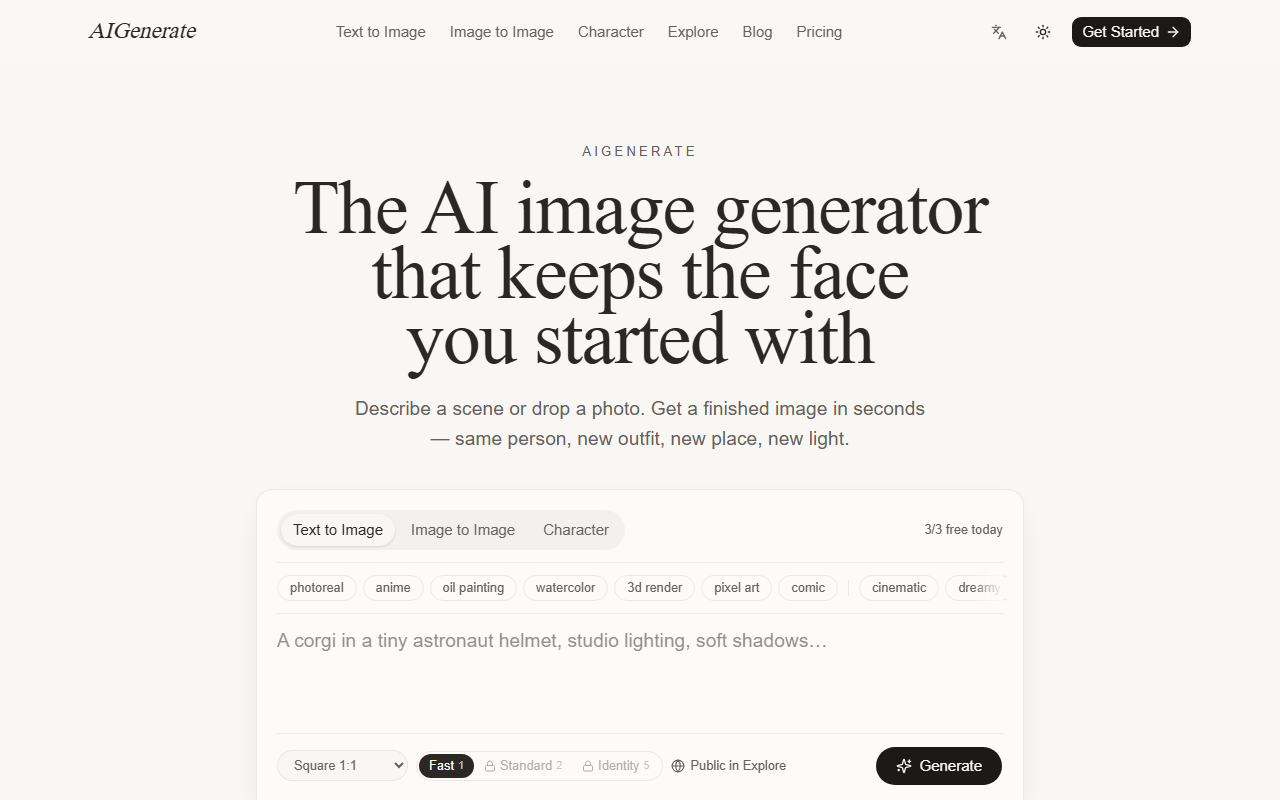
Most AI image generators are very good at producing a beautiful stranger. Ask for "the same woman, now in a raincoat at night" and you often get a different woman in a raincoat. If the deliverable is a character sheet, a storyboard or a product model across five outfits, that is not a near miss — it is a failed job.
Keeping the same face is mostly a reference problem, not a prompt problem. This guide covers what reference-based identity actually does, a workflow that holds up in practice, and the cases where no amount of reference fixes it.
Why the face changes between generations
A text-to-image model has no memory of the last image it made. Every request starts from noise, guided by words. Words like "same person" are not a memory instruction; they are a stylistic hint. Change the outfit, the lighting and the camera angle in one prompt and you have changed most of what the model uses to describe a face.
The symptom is familiar: the overall look survives while the details drift. The jawline softens, the freckles disappear, the eye colour shifts by a shade, the hairline moves. Each difference is small. Together they mean the character is someone else.
Two things fix this. Either the model is given an image to condition on — which is what reference-based generation does — or the whole set is generated in one pass with a fixed seed, which constrains style but not identity.
How reference-based identity works
Reference-based generation adds a second input alongside the text: one or more photographs of the person. The model extracts an identity embedding from those photos and conditions every generation on it.
With AIGenerate, that means up to fourteen reference photos per character and an explicit identity tier that preserves the face at 4K. The practical details matter more than the marketing:
- More references help, up to a point. Three to six clean photos covering front, three-quarter and profile beat fourteen near-duplicates from the same angle.
- Front-facing, evenly lit, no sunglasses. A reference where the face is half in shadow teaches the model that half the face is dark.
- One person per character. Group photos confuse the embedding, especially if two people share features.
- The tier is a real trade-off. A fast draft tier is fine for composition, and the identity tier is what you use for the frame that ships.
A workflow that holds up
The reliable pattern is to separate composition from identity. Decide the scene first, then spend your good credits on the one frame that matters.
- Build the character once. Generate or upload a reference set, and keep one clean front-facing portrait as the canonical reference. Everything else is derived from it.
- Draft wide. Use the fast tier to explore compositions — full body, close up, profile — while the identity is only roughly right. Do not judge a draft on the face.
- Lock the frame, then upgrade. Once the composition is right, regenerate that single frame on the identity tier. This is where the credits should go.
- Change one variable at a time. Outfit first. Then location. Then light. Changing all three at once makes it impossible to tell which change broke the likeness.
- Keep the prompt structure stable. Describe the same person the same way in every prompt, and put the change last. A stable subject clause plus a variable scene clause is more consistent than a fully rewritten sentence.
For a set of ten images, that usually means ten fast drafts and three identity passes, not ten identity passes.
Prompt habits that help
Plain prompts are rewritten into a structured English prompt before they reach the model, so the useful habits are about what you include rather than syntax.
- State the invariant explicitly: "the same woman, same face, same freckles".
- Keep a fixed descriptor block you paste into every prompt: age range, face shape, hair, distinguishing marks.
- Describe the scene as a separate clause: wardrobe, location, time of day, light direction.
- Avoid contradictions between reference and prompt. Asking for "clean-shaven" when the reference has a beard forces the model to choose, and it will choose the prompt.
- Say what the camera is doing. "Close-up, 50mm, soft window light" produces a more stable face than "cinematic portrait", because the second phrase is stylistic rather than geometric.
When it still fails
Identity conditioning is not a guarantee, and it is fair to know where it breaks.
Extreme angles. A profile or a downward three-quarter view has fewer recognisable features than a front view. Likeness degrades before the image does.
Occlusion. Masks, hands over the face, deep shadow, heavy makeup and helmets all remove the evidence the model checks against.
Age and expression extremes. Asking for a twenty-year age shift or a laugh that changes the face shape moves the target away from the reference.
Group scenes. Three characters in one frame means three identity sets. It can work, but consistency drops and small faces at the back of the frame are the first to drift.
Heavy stylisation. Anime, oil painting and pixel-art styles keep the composition and lose the micro-detail that makes a face recognisable. If the style is the point, expect resemblance rather than identity.
The honest summary is that reference-based generation gets you most of the way, and the last ten percent is editorial: pick the frame that reads correctly at the size it will be used.
FAQ
How many reference photos do I actually need?
Three to six well-lit photos from different angles are enough for most characters. Additional references help most when they add a new angle rather than another version of the front view.
Can it keep the same face in a completely different art style?
Partly. A style transfer keeps the character's proportions and distinguishing marks, but fine detail such as freckles or a small scar tends to disappear once the render stops being photographic. Judge it at the size the image will be published.
Does this work for product photography, not just people?
The same mechanism applies to any object with a consistent identity — a product shot with the same model, or the same item in different scenes. The reference requirements are the same: clear, evenly lit, one subject.
What happens if I upload photos of two different people?
The identity embedding blends them, and every generation will look like a relative of both. Keep one person per reference set. (The pricing page explains the credit tiers if you want to experiment cheaply on the draft tier.)
The takeaway
Keeping the same face across AI images is a reference problem first and a prompt problem second. Upload clean, multi-angle references, keep a fixed descriptor block, spend credits on the frame that ships, and expect the technique to thin out at extreme angles and heavy stylisation. Everything else is iteration.
Keep reading
AI lesson plans in ten seconds: what to check before you use them
AI can draft the lesson plan, the quiz and the feedback in seconds. Here is what has to be true before a teacher can actually hand it to a class.
Stop asking a chatbot: ten jobs that want a score, not a paragraph
For repeatable judgments, a fixed scoring dashboard beats a chat reply. Here are ten tasks where consistency matters more than flexibility, and how the scoring approach works.