
Stop asking a chatbot: ten jobs that want a score, not a paragraph
For repeatable judgments, a fixed scoring dashboard beats a chat reply. Here are ten tasks where consistency matters more than flexibility, and how the scoring approach works.
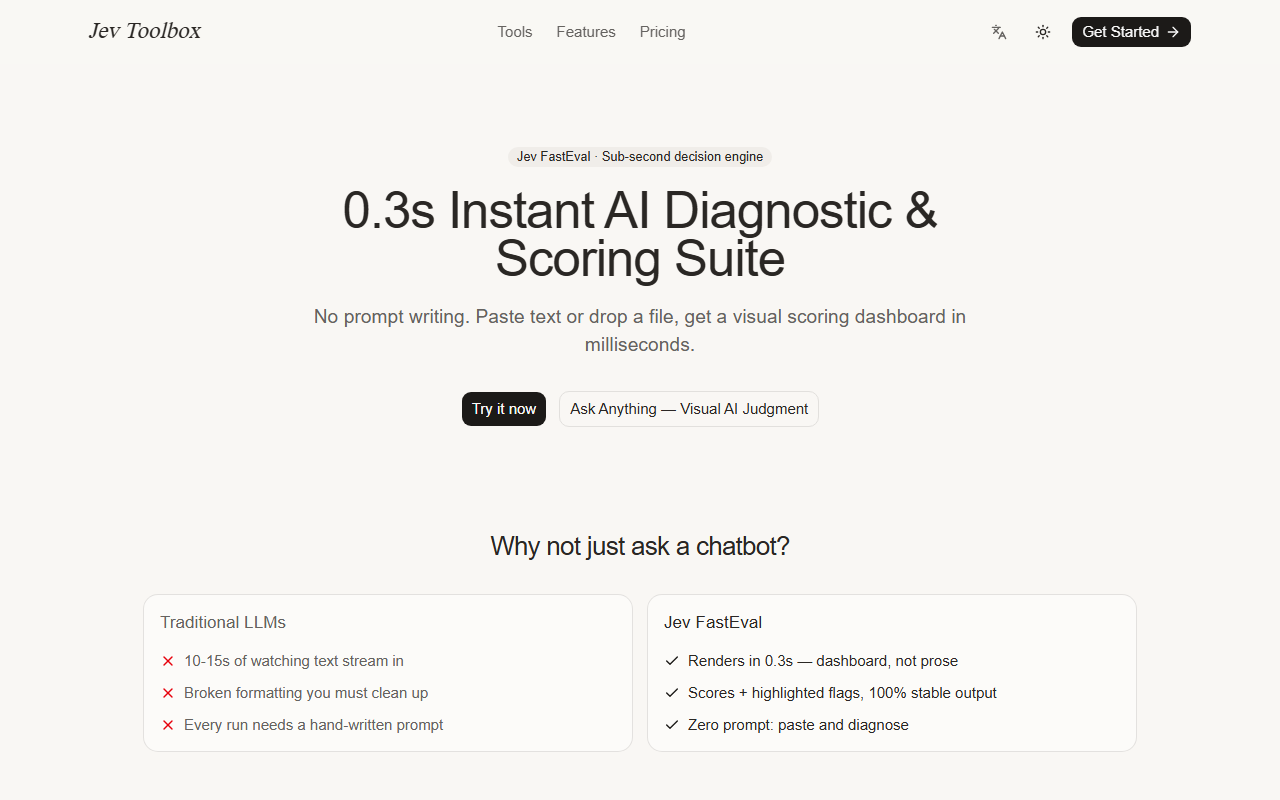
Asking a chat model "is this headline good?" produces a confident answer and no way to compare it to the answer you got yesterday. For one-off questions that is fine. For work you do every week — copy, resumes, ad compliance, error triage — the format is the problem, not the model.
A scoring tool inverts the interaction. You paste text, you get a number, the specific problems are highlighted, and the output has the same shape every time. This article covers why that matters and walks through ten jobs where it does.
The real cost of a chat-shaped answer
A chat reply is optimised for reading, not for deciding. Three costs follow.
The first is latency. A streaming answer takes ten to fifteen seconds to finish, and you cannot skim it until it has. A rendered dashboard arrives in a fraction of a second because it is not generating prose.
The second is formatting drift. Ask the same question twice and you get two different structures — sometimes a list, sometimes a paragraph, sometimes an unsolicited rewrite. If you want the answer in a spreadsheet or a ticket, you reformat it by hand.
The third, and the one that quietly matters most, is variance. A chat model is responsive to phrasing. Soften your question and it softens the verdict. That makes it a poor instrument for comparison: you cannot tell whether the second headline scored better or whether you sounded more confident when you asked.
A fixed evaluator removes all three. It is narrower on purpose, and narrower is the point.
Ten jobs that want a score
The Jev FastEval toolbox splits these into task-specific evaluators rather than one general-purpose grader. Grouped by what you are deciding:
Marketing and copy
- Headline click-through prediction. Paste two to five candidate headlines, get a ranked winner and a score for each. Useful when you have already written the options and need to pick one.
- Ad copy compliance. Flags absolute claims and risky wording in marketplace-style copy — the kind of phrase that gets an ad rejected after you have already scheduled it.
- Meta title and description appeal. Scores how a search snippet is likely to read in a results page, which is a different question from whether the page is good.
- Cold email spam risk. Separates deliverability risk from reply potential, because a message can be welcome and still land in the promotions folder.
Career and documents
- Resume against a specific job description. An ATS match score plus the biggest gap, which is more actionable than a general "your resume is strong".
- Contract risk scan. A risk score, the most dangerous clause category, and vague-wording flags. Explicitly a first pass — a lawyer still reads the thing.
Product and engineering
- JSON and API error classification. Paste a payload or a stack trace and get the error type, severity and where to look first. Useful in a triage rota where the same five failures recur.
- Buyer review pain-point categorisation. Paste five to a hundred reviews and get complaints grouped with an improvement priority, instead of forty quotes you read one by one.
Design and open-ended judgment
- Colour palette evaluation. Describe the brand positioning and get a scored palette with accessibility notes, which is a faster first pass than asking a designer to react to six options.
- Ask anything with a visual judgment. A ranked set of options with confidence, for questions that do not fit a template.
What consistency buys you
The practical benefit shows up when you run the same check repeatedly. Two examples from ordinary work.
A copywriter producing four ad variants a week can score all four before sending them, and over a month build a rough sense of which score actually correlates with performance in that account. That is a real feedback loop. With chat replies, there is nothing to compare, because the answer changed shape every time.
A developer triaging tickets can route by severity instead of by gut feel, and the category names stay stable enough to count. Counting is what turns a pile of errors into a fix list.
Neither example requires the score to be perfect. It requires the score to be consistent, fast and specific about what dragged it down.
Where a scoring tool is the wrong choice
Narrow evaluators are bad at open-ended work, and pretending otherwise wastes time.
If the task needs a rewrite rather than a verdict, use a chat model or an editor. If the task needs domain expertise you cannot verify — a novel legal question, a medical decision — a score is not evidence, and treating it as evidence is how people get hurt. If the task is genuinely one-of-a-kind, the setup cost of choosing an evaluator exceeds the value.
The honest rule: score what you repeat, chat about what you do not.
FAQ
How is this different from asking a chatbot to rate something out of ten?
A chatbot will rate something out of ten if you ask, but the scale means nothing across sessions and the reasoning changes with your phrasing. A fixed evaluator applies the same criteria in the same order every time, which is what makes the number comparable.
Are the scores accurate?
They are consistent heuristics, not measurements. Treat a score as a fast first pass that highlights where to look, and keep human judgment for anything that ships to a client, a candidate or a court.
What does the free tier cover?
Ten runs a day for registered users, no credit card. That is enough to test whether a given evaluator matches your own judgment on your own material. See the pricing details.
Can I use it for a resume I am sending today?
Yes, with one caveat: the ATS match score is a heuristic against one job description, not a prediction of any specific company's screening software. Use it to find the missing keyword, not to decide whether to apply.
The takeaway
For repeatable judgments, ask for a score. A consistent, fast, narrow evaluator beats a flexible one whenever you need to compare options, build a feedback loop, or route work by severity — which is most of the time in a real job. Keep the chat window for the questions you will only ask once.
Keep reading
AI lesson plans in ten seconds: what to check before you use them
AI can draft the lesson plan, the quiz and the feedback in seconds. Here is what has to be true before a teacher can actually hand it to a class.
How to keep the same face across AI images (and when it still fails)
A practical workflow for consistent character generation — how reference-based identity works, what breaks it, and the prompt habits that keep a face stable across scenes.