
本文目录
Ask a hundred writers what they want from an AI writing helper and most will describe a ghostwriter. Ask what actually blocks them and the answer is smaller and more specific: the draft stalled at chapter eleven, the book keeps explaining the same idea, or the chapter that was meant to be 1,400 words came out at 600 and broke the pacing.
There is also a quieter problem, and it is the one that decides whether the book is worth reading: the helper writes beautifully about nothing in particular. The sentences are clean, the structure is tidy, and the book has no weight. That is what happens when a model works from its own average instead of from your material.
Those are four different jobs, and they need four different mechanisms. A helper that only generates text addresses none of them well.
The four jobs that matter
Job one: unstick the next chapter
Writer’s block is usually not a lack of words. It is an unresolved decision: should this chapter teach the drill or tell the story of the player who needed it? Until that decision is made, every sentence is a detour.
A useful helper does not write past the decision. It asks for it. The most productive prompt is not “continue the chapter” but a short list:
- What should the reader be able to do after this chapter that they could not do before?
- What is the one case or number that proves it?
- What would make a reader skip this chapter, and how do we remove it?
Answer those three and the chapter usually writes itself. A helper that asks before it drafts is worth more than one that drafts 2,000 words you have to delete.
There is a smaller version of stuck too: the chapter is going fine but stopped one beat early. The explanation has started but not landed; the drill is described but not shown. That is what Continue is for — finish the beat in front of you with a steering note (“end with the parent trying it at home”), not start a new chapter.
The mirror-image mistake is continuing a chapter that has already delivered its lesson. You get a coda, then another coda, and the chapter stops moving. If the change the goal asked for has happened, stop.
Job two: bring your material in
This is the job most helpers skip, and it is the difference between a book that sounds like every other book and one that sounds like you.
If your experience lives in files — training logs, client notes, lesson plans, old drafts — a good helper should be able to read them. In our editor, you drop those files into a knowledge base as markdown or text, group them into libraries, and mount a library to the book. While writing, you choose which library the chapter may consult.
The result is not decorative. Ask for a chapter on fixing a flat-set elbow, and the helper can pull the actual drill you used, the actual six-week case, the actual mistake you made in year two. Ask it to write the same chapter from a blank prompt, and you get the average of every shooting article on the internet: correct, smooth, and useless.
A simple test for any helper: can you point to the sentence where your experience appears? If not, the helper is writing about your topic, not from it.
Job three: keep continuity across chapters
This is the job every writer underestimates until it is too late.
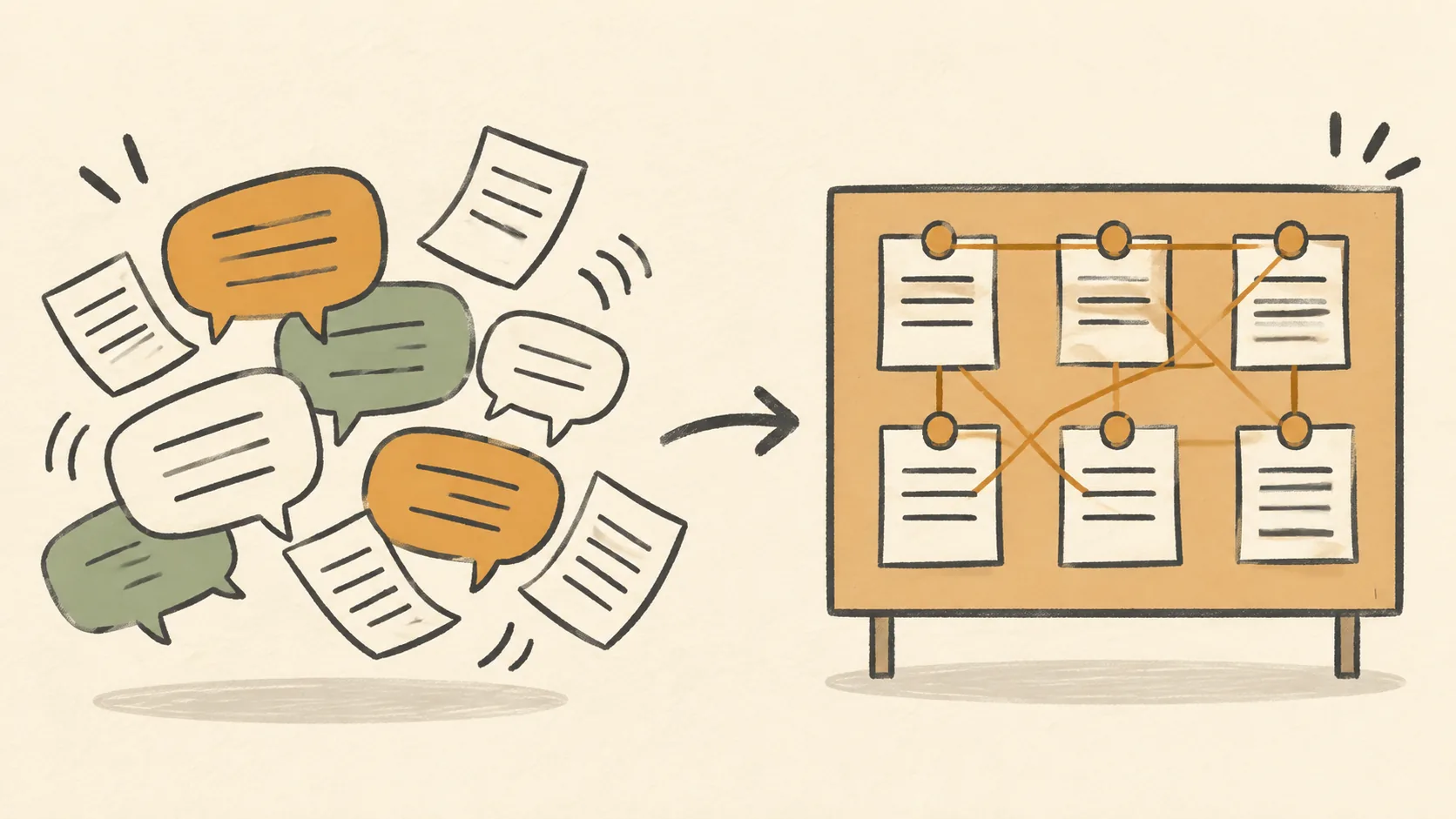
At 80,000 words, a cast of a dozen cases and a timeline of ten years, no one holds the book in their head — not the writer, and certainly not a chat window. The things that break are specific: a number changes, a term is defined twice, a case introduced in chapter two is retold as new in chapter nine, who did what and when.
The fix is not a better model. It is making the book’s state explicit and injecting it.
In our editor that state lives in Global knowledge, and it has three parts:
- Facts — labeled claims the book must never contradict. “First gym: Huaihai Road, twelve courts, no heating” is a fact. “The gym was important” is not; nothing can contradict it.
- Already covered — the topics the book has explained, so new chapters are told not to re-teach them.
- Voice & structure — tone, person, rhythm and formatting rules, injected verbatim.
After each chapter is saved, the editor writes a short recap that becomes the context for the next chapter. That is the mechanism that keeps chapter thirty from re-explaining chapter three.
Job four: hold the length
Length is where good drafts quietly become unplannable.
A chapter that was supposed to be 1,400 words comes back at 600. The next one comes back at 2,400. Six chapters in, the book has no rhythm and the reading time is a guess. Editors and readers feel this before they can name it.
A helper should let you set the unit. In our editor, chapters default to 1,200 words and can be set from 400 to 4,000, per book. That is not a style rule; it is a planning tool. A 25,000-word guide at 1,200 words a chapter is about 21 chapters. A 70,000-word memoir is about 58. When the count is predictable, the plan is checkable.
What the helper should not do
- Decide the book. Direction is the writer’s job. A model that chooses what happens will choose the average of what happens in books like yours.
- Invent your experience. If a case, a number or a quote is not in your notes, the helper should say so, not fill the gap with something plausible.
- Rewrite whole chapters in one pass. Voice disappears in large rewrites. Ask for a diagnosis, then a targeted fix.
- Praise you. A helper without a critical mode becomes an echo chamber. Ask it what is broken, not whether the chapter works.
- Replace the reading. The recap is a compressed book; someone still has to read it. That someone is you.
The idea-guy problem
There is a specific kind of writer who benefits most from a helper and is also most at risk: the one with more ideas than time, who can outline brilliantly and writes prose reluctantly.
The risk is that the helper takes over the structure, because it is faster than arguing with it. The first two chapters feel like collaboration. By chapter five the book has a shape you did not choose, and you are no longer sure whether you like it.
The guardrail is simple: your outline, your facts and your notes stay fixed, and the helper works inside them. Chapters, cases and goals are yours. The helper’s job is to draft against them, flag contradictions, and ask the next question. If it starts proposing a different book, that is a bug, not a feature.
A working week with a helper
| Day | Job | What you do |
|---|---|---|
| Monday | Plan the block | Write or revise the goals for the next five chapters |
| Tuesday | Draft | Generate chapters, one at a time, checking each against its goal |
| Wednesday | Continuity | Read the recaps, fix facts, resolve contradictions |
| Thursday | Draft | The chapter the book turns on — alone, no batch generation |
| Friday | Diagnose | Ask what is broken; decide what is real |
| Weekend | Rest | Read something else; let the draft cool |
The rhythm matters more than the tool. A helper used every day for twenty minutes beats one used in a panic at the end.
The bottom line
A book writing helper earns its place by doing four unglamorous jobs: it asks the question that unsticks the chapter, it reads your material instead of inventing, it holds the state you cannot hold, and it keeps the chapter at the length the plan needs. Everything else — the flourishes, the brainstorming, the pep talk — is optional. Get the four right and the book moves. Get them wrong and no amount of generation will finish it.
Key takeaways
- 1Unstick by asking for the chapter’s decision, not by generating past it.
- 2The helper should read your notes from a mounted knowledge base, not invent your experience.
- 3Continuity is stored state — facts, covered topics and voice rules — not model memory.
- 4Set chapter length as a planning decision; predictable length makes the plan checkable.
- 5If a case is not in your notes, the right answer is a gap, not a plausible fabrication.
常见问题
What should an AI book helper do?
Four things: help you find the next chapter when the draft stalls, read from your own notes instead of inventing, hold the facts steady across chapters, and keep each chapter at a length that fits the plan. Text generation is the easy part and the least valuable.
Is AI a good writing coach?
It can be, if you ask it to diagnose rather than praise. “Find three places where the reader stops learning” is useful. “Is this good?” produces flattery. The helper is only as honest as the question.
Can an AI writing helper finish my book?
No. It can draft chapters, carry a recap, and keep facts straight. The decisions about what only you can teach, what to cut and what the reader takes away are still yours. A helper that promises more is selling a demo, not a book.
How do I stop an AI helper from changing my voice?
Write the voice rules down once — tone, person, sentence rhythm, words you refuse — and have them injected into every chapter. Then use the helper for diagnosis and targeted rewrites, not whole-chapter rewrites. If a suggestion flattens your voice, reject it.
参考资料
关于作者

每两周,一封有用的信
关于写作、发布,以及产品上线前后那些不体面的细节。没有热点合集,也没有增长黑客。