本文目录
- Why consistency breaks
- The five locks
- Lock one: an approved reference image
- Lock two: a written character sheet
- Lock three: one fixed style sentence
- Lock four: a scene brief per image
- Lock five: a negative list
- A workflow that holds across a book
- Where AI illustration actually earns its place
- The cover is a different job
- Rights, disclosure and the illustrator question
- The consistency checklist
- The bottom line
The first illustration is easy. You describe a character, pick a style, and get something that looks like the book in your head. It is a small miracle, and it is also the least useful thing the tool will do.
The useful thing is image twenty: the same character, three chapters later, in a different room, at a different age, still recognizably themselves. That is where illustration stops being a toy and starts being a product.
Most AI illustration fails exactly there, and the failure is not a prompt problem. It is a memory problem.
Why consistency breaks
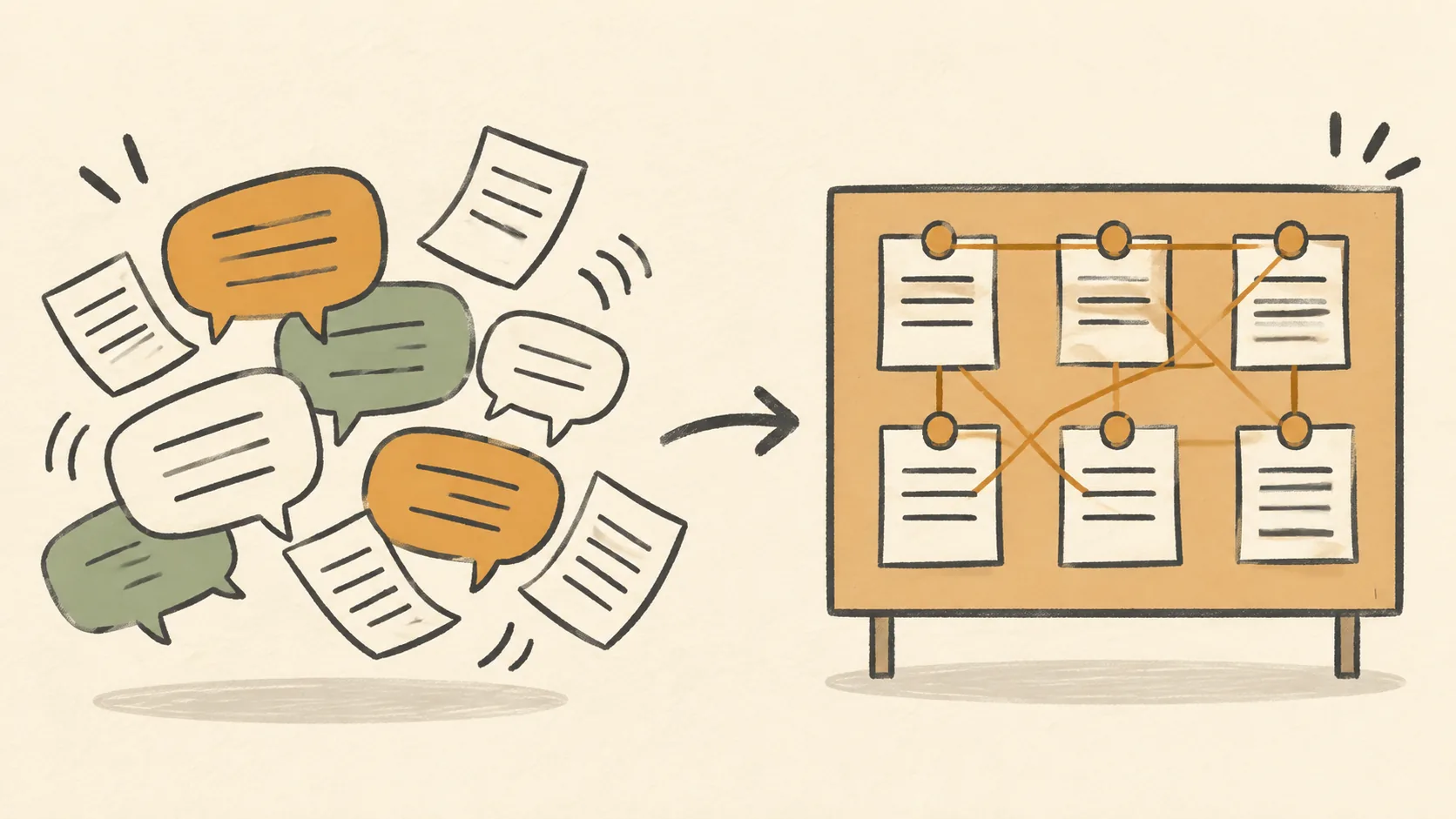
An image model has no persistent identity for your character. Every prompt is a new casting call. Unless you supply the same description, the same style and the same constraints, the model will independently invent a plausible person who happens to match the adjectives.
Three drifts happen first:
- Face drift. The jaw softens, the eyes change shape, the age moves by a few years.
- Wardrobe drift. The coat changes cut and color; the scar moves from the left cheek to the right.
- Style drift. Line weight, palette and rendering shift, so two images look like they came from two different books.
A reader will not name these. They will just feel that the book looks assembled rather than made.
The five locks
Lock one: an approved reference image
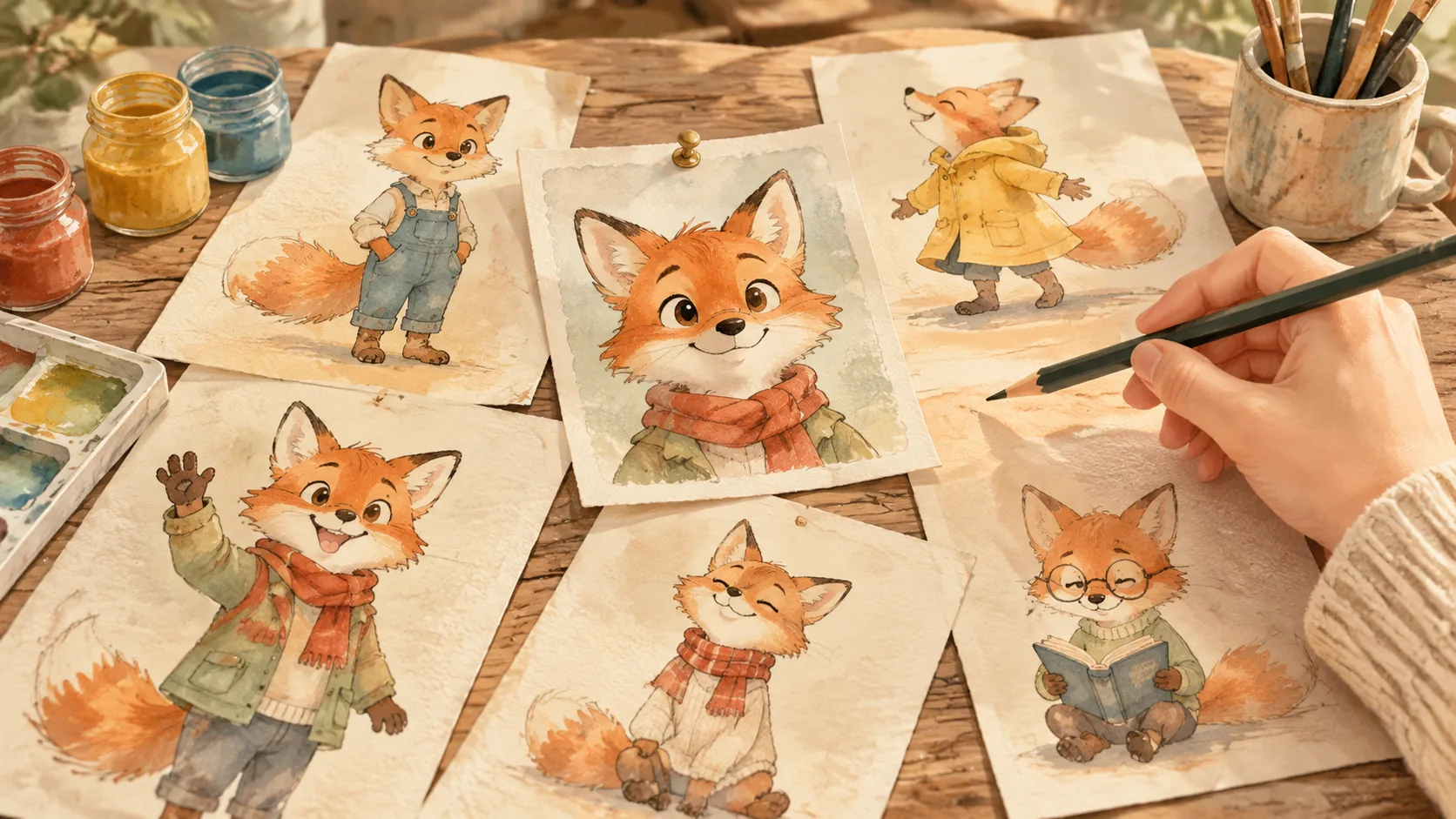
The strongest form of a character description is a picture. Generate three candidates, pick the one that matches the book in your head, and from then on attach that image to every prompt:
Use the character from the first image — same face, same hair, same coat. Show her unlocking the shop door before opening time.
A reference image beats a paragraph of adjectives because the model no longer has to guess what “round face, tired eyes” means. It can see the face it is supposed to keep.
If your tool can take a reference image, use it before you write a single adjective. If it cannot yet, a written sheet is the fallback — and a good reason to choose a different tool for a picture book.
Lock two: a written character sheet
Write the character down anyway, in the terms an illustrator would use.
| Field | What to write |
|---|---|
| Face | Shape, nose, eyes, eyebrows, jaw, one distinguishing mark |
| Hair | Length, texture, how it is worn, color in neutral light |
| Build | Height relative to others, shoulders, posture |
| Palette | The three colors that always appear on this character |
| Outfit | One signature garment, and what changes with season or status |
| Props | The object they are rarely without |
| Never changes | The two or three things that must survive every image |
The “never changes” row is the one that saves you. “Round wire glasses, a burn scar on the right wrist, always slightly unshaven” gives every future prompt something to check.
The sheet belongs in the book’s Global knowledge as facts, so the text describes the character the illustrations show. If the sheet says gray eyes and chapter twelve says green, one of them is wrong, and the fact is where you catch it.
Lock three: one fixed style sentence
Style drifts when the style description drifts. Write one sentence and never change it.
A workable template:
Soft ink-and-wash illustration, warm cream paper, muted earthy palette, thin charcoal linework, no gradients, gentle paper grain.
Then add the scene. Do not rewrite the style sentence per image, even if the scene is dark or comic. If the book needs two visual modes — a warm present and a cold past — define two style sentences and label every image with the mode it belongs to.
For a practical book, the equivalent rule is simpler: pick one line weight and one palette for diagrams, and never mix three icon styles in one chapter. Consistency matters even when the “character” is a labeled diagram of a knee.
Lock four: a scene brief per image
An illustration is not decoration. It has a job in the reading experience: establish a place, reveal a relationship, or show something the text deliberately withholds.
A scene brief answers four questions:
- What moment? One beat, not a chapter.
- Whose eyes? The image should feel like it belongs to a point of view.
- What must the reader learn? The one thing the image is for.
- What must stay out? The spoiler, the crowd, the detail that distracts.
If you cannot answer question three, the image is decoration, and decoration is where budgets go to die.
Lock five: a negative list
Every book has things that must not appear: a modern object in a historical scene, a brand, a color that belongs to another character, gore in a children’s book, an extra finger.
Keep the list short and specific. Ten items beat fifty. Add to it every time you regenerate an image, because each regeneration is evidence of what the model gets wrong.
A workflow that holds across a book
- Approve a reference image. Three candidates, pick one, keep it.
- Write the character sheets. One per recurring character, in the same format.
- Write the style sentence. One, or two labeled modes.
- Generate three test images. Different scenes, same character. Compare side by side.
- Fix the locks, not the images. A single bad image is a regeneration. A drifting face is a reference problem.
- Batch by scene, not by character. Generate in reading order so wardrobe and age stay consistent with the timeline.
- Review in a contact sheet. Put twenty thumbnails on one screen. Drift is obvious at thumbnail size and invisible one image at a time.
- Regenerate one, never all. When an image is wrong, replace that image. Re-rolling the set is how a book loses its look.
Where AI illustration actually earns its place
Three kinds of books get the most from it, and they are not the same job.
- Children’s books and picture books. The character must survive every page; the reference image does most of the work. Buyers are also the most sensitive audience, so disclosure and honesty matter more here than anywhere else.
- Coloring books and activity books. The whole product is line art: consistent line weight, closed shapes, no shading. A fixed style sentence and a hard negative list matter more than character likeness.
- Practical and experience books. The “illustrations” are usually diagrams, tables and step photos. The consistency problem is visual language — same arrows, same labels, same icon style — rather than faces. A reader should not be able to tell which chapter’s diagram was made on a different day.
For a book built from your experience, the images are part of the teaching, not decoration. A diagram that contradicts the text is the same failure as a chapter that contradicts a fact.
The cover is a different job
An interior illustration supports a scene. A cover sells the book, and it is judged at thumbnail size in a list of competitors.
That changes the priorities:
- Typography first. The title has to be legible before the image is understood. A beautiful cover with an unreadable title is a failed cover.
- Silhouette over detail. The image must read at 200 pixels wide. Fine texture disappears; shape survives.
- One idea. A cover that says three things says nothing.
- Genre and shelf signals. Readers scan for the conventions of the shelf they are browsing, then judge execution.
Our cover generator is built around that order: you set the title, subtitle and author, a visual direction, a style and a ratio, and the title typography is treated as the focal point — the model is asked to render it letter for letter and keep it legible at thumbnail size. It is a starting point, not a replacement for a designer, but it gets the hardest constraint right.
Rights, disclosure and the illustrator question
AI illustration is legal in many places and contested in most of them. Three rules keep you out of unnecessary trouble:
- Do not imitate a living illustrator’s recognizable style. “In the style of [artist name]” turns a person into a style library. Describe qualities instead.
- Use reference images you have the right to use. Your own sketches, your own photos, or material you have licensed. A reference image is not a loophole.
- Disclose where the platform asks. Children’s books and gift books are judged harder than genre fiction. A clear note costs less than a discovered omission.
- Know what the human alternative costs. A full picture book from an illustrator commonly runs several hundred dollars and weeks of schedule. That is the number AI is competing with, and it is also the number that tells you when a project deserves a human.
The honest framing: AI illustration makes illustrated books possible for projects that would otherwise have none. It does not make an illustrator unnecessary for books where the art is the reason to buy.
The consistency checklist
- Reference image approved before the first batch.
- Character sheet written and stored as facts.
- One style sentence, unchanged across the book.
- Scene brief with a job for every image.
- Negative list of ten specific items.
- Three test images before batching.
- Contact-sheet review after every batch.
- Single-image regeneration, never whole-set.
- Cover judged as a thumbnail, title first.
- Disclosure checked against the platform.
The bottom line
An AI book illustration generator is not a picture machine. It is a consistency system with a picture machine attached. Approve the reference image, write the character down, fix the style, brief every scene, and judge the book at thumbnail size. Do that and image twenty looks like image one. Skip it and you have twenty nice pictures of twenty different people.
Key takeaways
- 1Consistency is the product; one good image is the easy part.
- 2A reference image beats a paragraph of adjectives — approve one, attach it every time.
- 3Five locks: reference image, character sheet, style sentence, scene brief, negative list.
- 4Test three images before batching — fix the locks, not the pictures.
- 5Children’s, coloring and practical books each need a different kind of consistency.
常见问题
Can AI illustrate a whole book?
It can generate the images, but consistency is the constraint. A character needs an approved reference image, a written sheet, a fixed style and a scene brief for every image. Without those, the face drifts by the fifth illustration.
How do I keep a character consistent across illustrations?
Start with one image you approve, then attach it as a reference to every later prompt: “use the first image for the character, show her opening the shop.” Keep a written sheet beside it, fix the style in one sentence, and test three images before batching the rest.
Is AI illustration allowed in children’s books?
Platform rules vary and readers have strong opinions. Disclose AI involvement where the platform asks, do not imitate a living illustrator’s recognizable style, and expect buyers to care more in children’s books than anywhere else.
Should I use AI for the cover too?
A cover is a sales asset, not an interior illustration. It has to work as a thumbnail, which means the title has to be legible before anything else. Our cover generator treats typography as the focal point and lets you set the direction and style.
参考资料
- Amazon KDP — Content guidelines: AI-generated content — 查阅于 2026-11-18
关于作者
每两周,一封有用的信
关于写作、发布,以及产品上线前后那些不体面的细节。没有热点合集,也没有增长黑客。