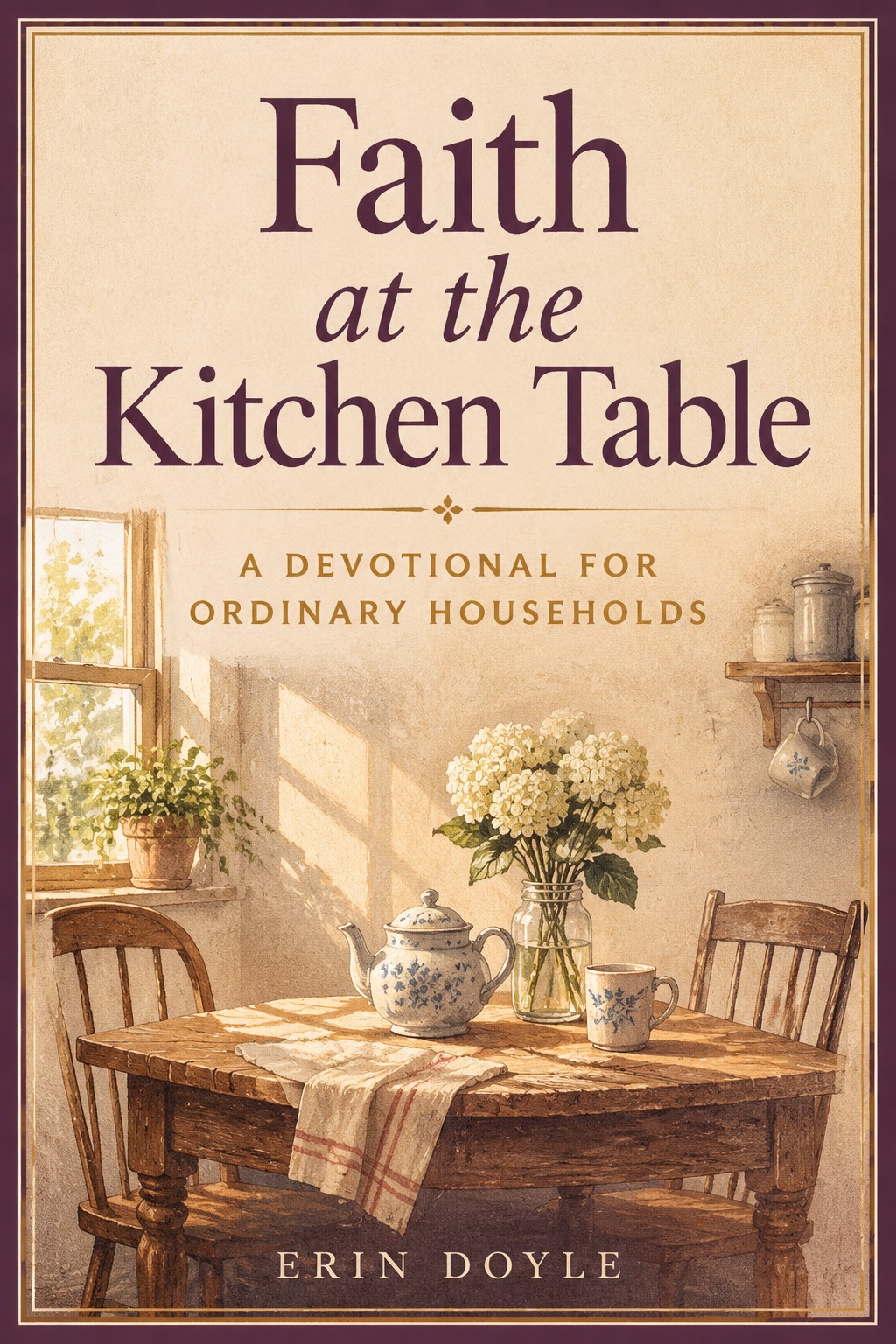
Faith at the Kitchen Table
A devotional for ordinary households
by Erin Doyle
Fourteen short readings about faith in the ordinary: the washing-up, the school run, the argument that was handled well, the guest who stayed too long. Written for households rather than retreats.
How this one was built
Built from the devotional template. The household practice was held as a key fact, so no reading ended without something doable at home.
Sample only — the manuscript is not for sale. The plan is free to copy.
Read day one
The opening, in full. About 1 min. Turn the pages with the arrows, your keyboard, or a swipe.
Day 1
The table
The most honest record of a family's week is probably the table. Not the good table, set for guests — the ordinary one, with the pile of post at one end and somebody's headphones at the other. Who sits there, who eats standing up, who has not been invited in years.
Faith is practised at tables before it is written in journals. Jesus spent a remarkable amount of time eating with people, including people who had no business being at his table. The meal was not a pause between the important work. It was the work.
Most of us think of hospitality as something we will do when the house is finished. When the spare room is sorted, when we can cook properly, when we are less tired. The result is that we wait for a version of our lives that may never arrive, and the table stays closed.
What's inside
1 days · 281 wordsEvery day in the book, with the one-line recap it is written against. The first is free above; the rest arrive as empty pages when you copy the plan, and cost 3 credits each to write.
Day 1 — The table
A table is a small altar. Notice who is missing from yours, and invite one of them this week.
Who it is for
For people who love the idea of a daily quiet time and have a kitchen full of other claims.
What you end up with
Fourteen days of readings paired with one small household practice each day.
Build mine from this
Plan free · 1 credits to write the daysYou get the same 1 days, in the same order, with the same recaps — and an empty page under each one. Change the title and the angle, then write it in your own words.
Or start with your own idea
Pick the type, write the premise, and the plan gets generated for your topic instead. Export it as EPUB when it is done.