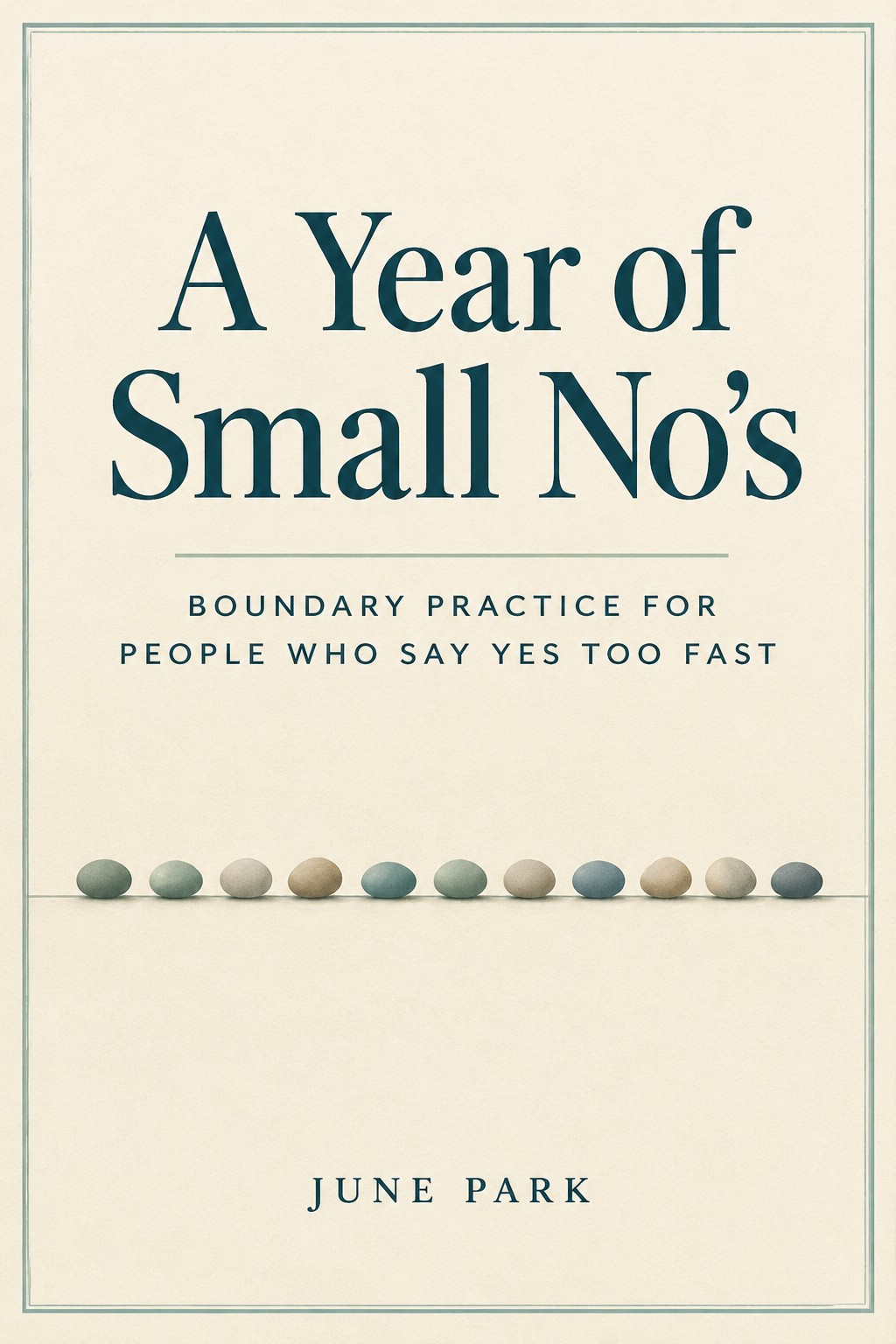
A Year of Small No's
Boundary practice for people who say yes too fast
by June Park
Fifty-two small practices for answering slowly, meaning it, and surviving the silence afterwards. No scripts that sound like a lawyer wrote them — just practice, one week at a time.
How this one was built
Built from the workbook template: one practice per week, each small enough to finish inside a single conversation.
Sample only — the manuscript is not for sale. The plan is free to copy.
Read the first week
The opening, in full. About 2 min. Turn the pages with the arrows, your keyboard, or a swipe.
Week 1
The two-second pause
The yes arrives before the question has finished. A colleague asks for a favour, a relative suggests a plan, a client adds one more thing to the scope — and your mouth is already saying "sure" while the rest of you is still calculating whether you have the time, the energy, or any interest at all.
You are not weak. You have learned that a fast yes ends the uncomfortable part of the conversation, and it does. The cost simply moves to a later date, where it shows up as a Tuesday with three extra commitments and a quiet resentment you cannot quite locate.
What's inside
1 weeks · 367 wordsEvery week in the book, with the one-line recap it is written against. The first is free above; the rest arrive as empty pages when you copy the plan, and cost 3 credits each to write.
Week 1 — The two-second pause
Answer nothing on the first pass. Buy two seconds and find out what your face already knew.
Who it is for
For the person who agrees in the meeting and regrets it in the car park.
What you end up with
A slower yes, an easier no, and a calendar that reflects what you actually chose.
Build mine from this
Plan free · 1 credits to write the weeksYou get the same 1 weeks, in the same order, with the same recaps — and an empty page under each one. Change the title and the angle, then write it in your own words.
Or start with your own idea
Pick the type, write the premise, and the plan gets generated for your topic instead. Export it as EPUB when it is done.