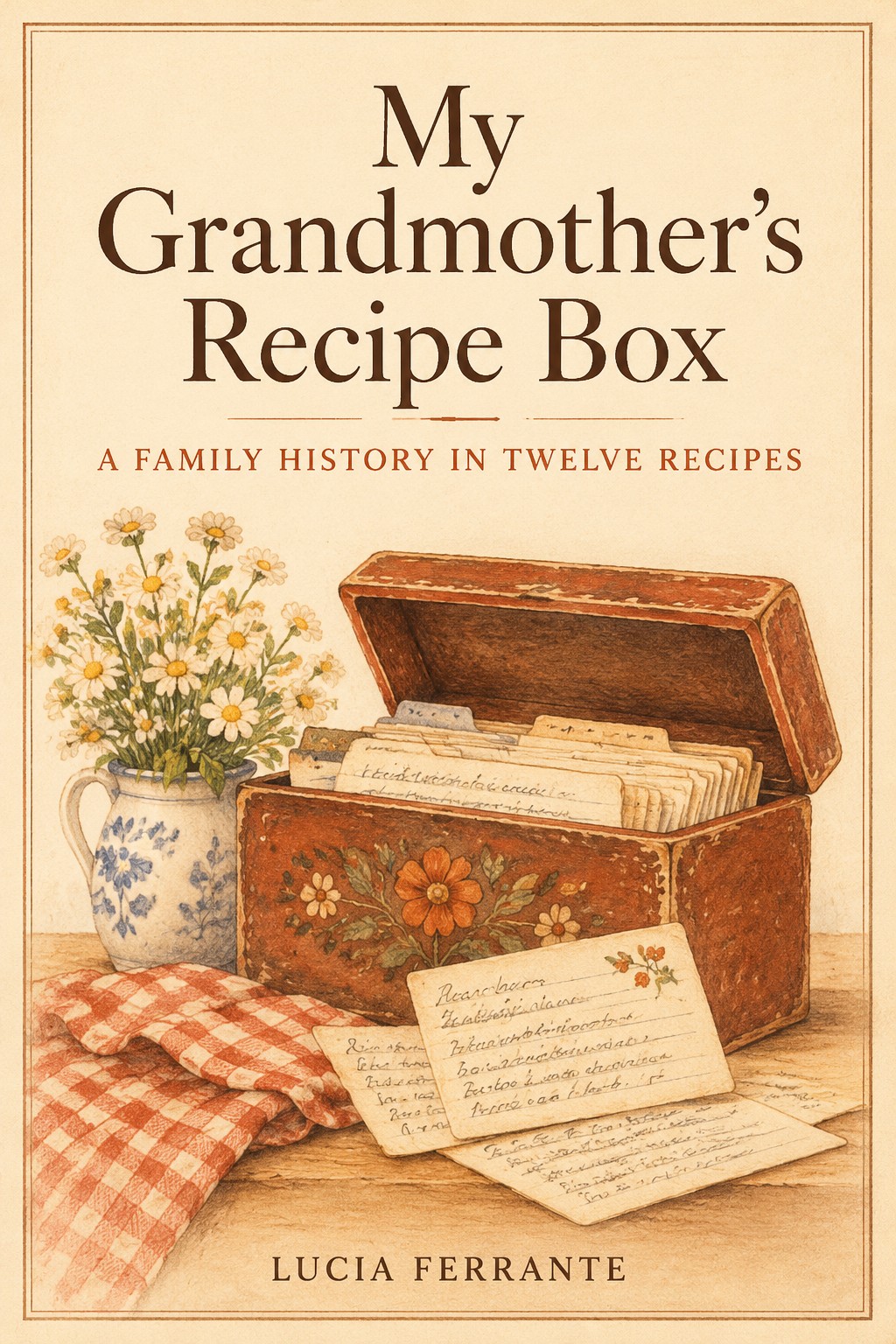
My Grandmother's Recipe Box
A family history in twelve recipes
by Lucia Ferrante
After her grandmother dies, Lucia finds a tin box of handwritten recipe cards — and uses each one to reconstruct a life that was mostly spent in a kitchen and rarely spoken about.
How this one was built
Built from the memoir template. The twelve-card structure was held as a key fact, one recipe per chapter, so each story stays tied to a real dish.
Sample only — the manuscript is not for sale. The plan is free to copy.
Read the first chapter
The opening, in full. About 2 min. Turn the pages with the arrows, your keyboard, or a swipe.
Chapter 1
The box on the top shelf
My grandmother did not keep a diary. She kept a tin box, and the tin box was on the top shelf of the cupboard above the stove, which was the hottest place in the flat and the place where she put things she did not want anyone to touch.
We found it on the third day, after the family had taken the furniture and the photographs and the good plates. My mother was in the kitchen with a bin bag, and I was doing what I usually do at family gatherings, which is standing in a doorway holding something and waiting to be told where to put it.
"What is this?" I said.
My mother looked at the box without taking it. "Her recipes."
"Handwritten?"
"Some of them. She never used a book. She had a book once, and she said it got the amounts wrong."
What's inside
1 chapters · 381 wordsEvery chapter in the book, with the one-line recap it is written against. The first is free above; the rest arrive as empty pages when you copy the plan, and cost 3 credits each to write.
Chapter 1 — The box on the top shelf
The recipe box is the only thing in the flat that is not labelled, and it is the only thing worth keeping.
Who it is for
For readers who have inherited a box of recipes and a family that does not talk about the past.
What you end up with
A full memoir plan: twelve recipes, twelve stories, and a family history told through the food that survived it.
Build mine from this
Plan free · 1 credits to write the chaptersYou get the same 1 chapters, in the same order, with the same recaps — and an empty page under each one. Change the title and the angle, then write it in your own words.
Or start with your own idea
Pick the type, write the premise, and the plan gets generated for your topic instead. Export it as EPUB when it is done.