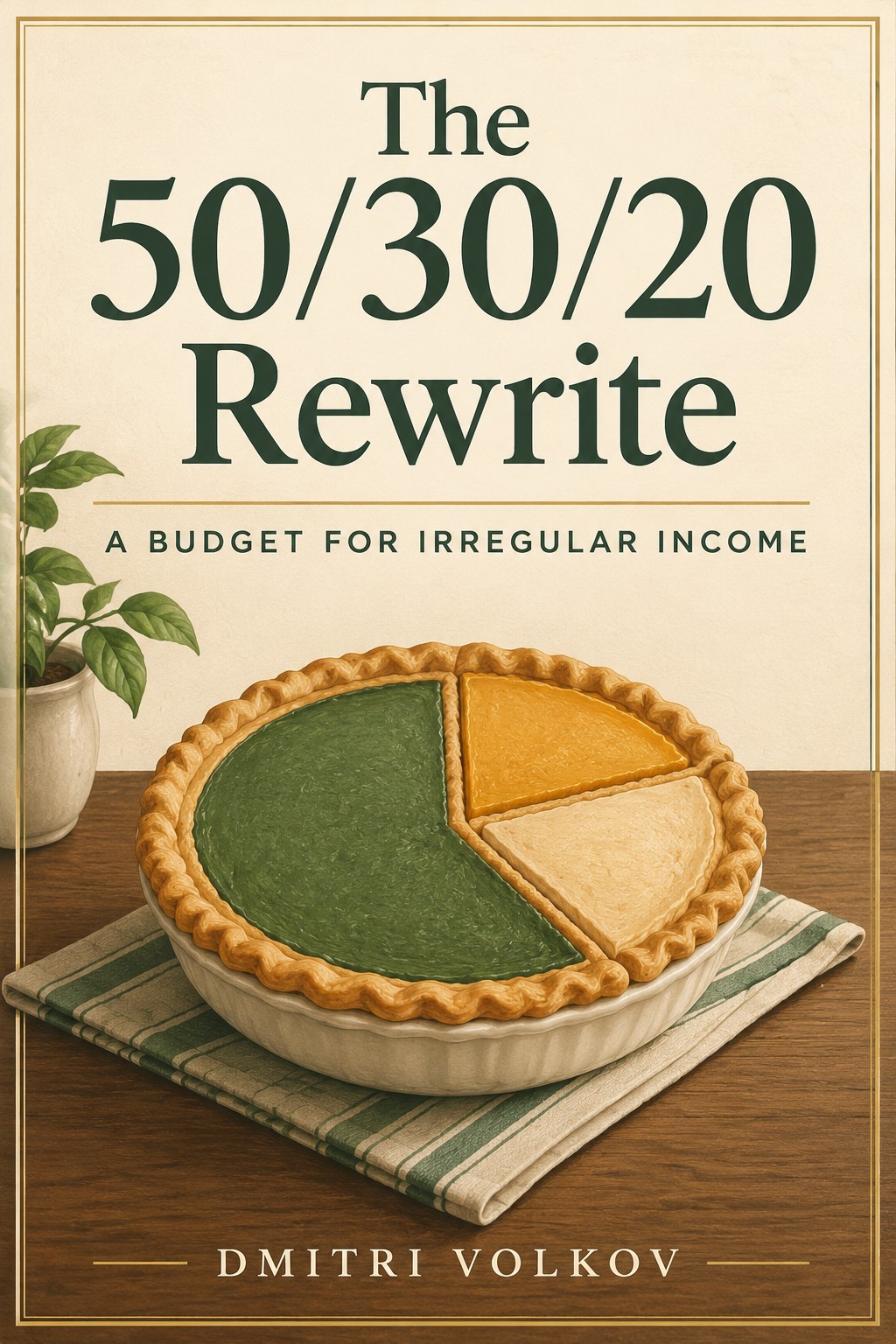
The 50/30/20 Rewrite
A budget for irregular income
by Dmitri Volkov
A budget method for freelancers, shift workers and anyone whose income changes. Start from the floor instead of the average, fund the fixed costs first, and give the good months a job.
How this one was built
Built from the guide template. The floor-income rule was a key fact, so the examples never used an average month as the baseline.
Sample only — the manuscript is not for sale. The plan is free to copy.
Read the first chapter
The opening, in full. About 2 min. Turn the pages with the arrows, your keyboard, or a swipe.
Chapter 1
Budget from the floor, not the average
The 50/30/20 rule — half on needs, thirty per cent on wants, twenty per cent on savings — is a good idea built on a bad assumption. It assumes the same amount arrives every month, on time, so that a percentage means something. If your income is a salary, that assumption holds. If you freelance, work shifts or run a small business, it does not.
The percentages fail in a specific way. In a good month, they tell you to spend more, because thirty per cent of a good month is a large number. In a bad month, the same percentages demand spending you cannot afford. The budget becomes a measure of the month rather than a plan for it.
What's inside
1 chapters · 367 wordsEvery chapter in the book, with the one-line recap it is written against. The first is free above; the rest arrive as empty pages when you copy the plan, and cost 3 credits each to write.
Chapter 1 — Budget from the floor, not the average
Find the lowest month you can reasonably expect, and build the plan on that number only.
Who it is for
For people whose income arrives in lumps, seasons or unpredictable shifts.
What you end up with
A monthly plan built on your lowest realistic income, with a surplus rule for the good months.
Build mine from this
Plan free · 1 credits to write the chaptersYou get the same 1 chapters, in the same order, with the same recaps — and an empty page under each one. Change the title and the angle, then write it in your own words.
Or start with your own idea
Pick the type, write the premise, and the plan gets generated for your topic instead. Export it as EPUB when it is done.