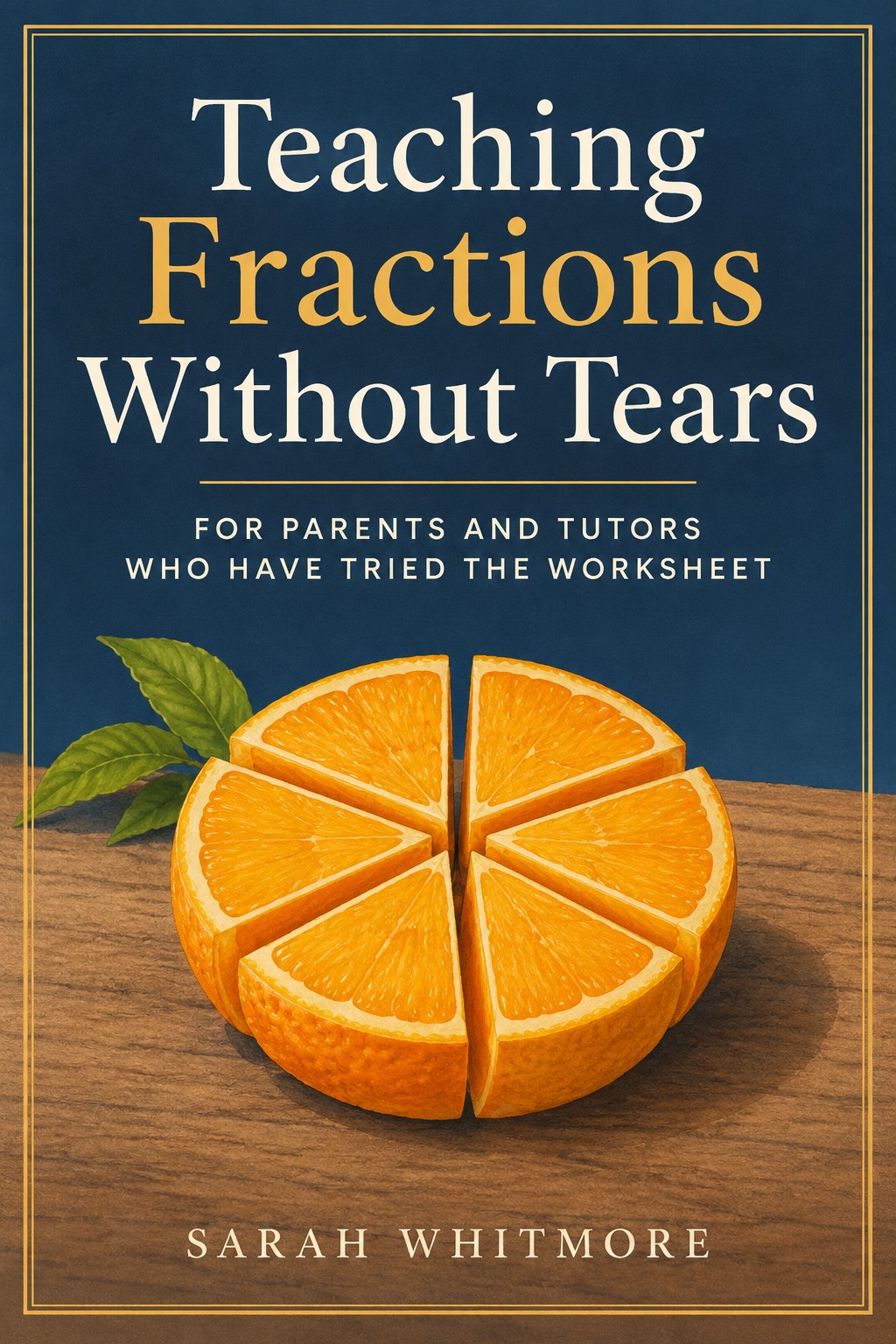
Teaching Fractions Without Tears
For parents and tutors who have tried the worksheet
by Sarah Whitmore
A guide to the order in which fractions actually make sense, with the four manipulatives that do most of the work and the five sentences that cause most of the confusion.
How this one was built
Built from the guide template. The sequence was held as a key fact; every chapter ends with something the adult can do today.
Sample only — the manuscript is not for sale. The plan is free to copy.
Read the first chapter
The opening, in full. About 1 min. Turn the pages with the arrows, your keyboard, or a swipe.
Chapter 1
Start with the whole
Almost every fraction problem a child gets wrong in Year 5 traces back to a missing answer to one question: what is the whole?
Half of what? A third of which bar? The child who answers "half" to "what is half of twenty-four" is not being careless. They have learned that half is a word that goes in the answer, and nobody has shown them that half is a relationship between two things, one of which is the bar.
What's inside
1 chapters · 317 wordsEvery chapter in the book, with the one-line recap it is written against. The first is free above; the rest arrive as empty pages when you copy the plan, and cost 3 credits each to write.
Chapter 1 — Start with the whole
Before a child can work with parts, they need one solid idea: what exactly is the whole?
Who it is for
For parents and tutors of children aged eight to twelve who are stuck on fractions.
What you end up with
A clear teaching sequence, printable practice ideas and language that does not create misconceptions.
Build mine from this
Plan free · 1 credits to write the chaptersYou get the same 1 chapters, in the same order, with the same recaps — and an empty page under each one. Change the title and the angle, then write it in your own words.
Or start with your own idea
Pick the type, write the premise, and the plan gets generated for your topic instead. Export it as EPUB when it is done.