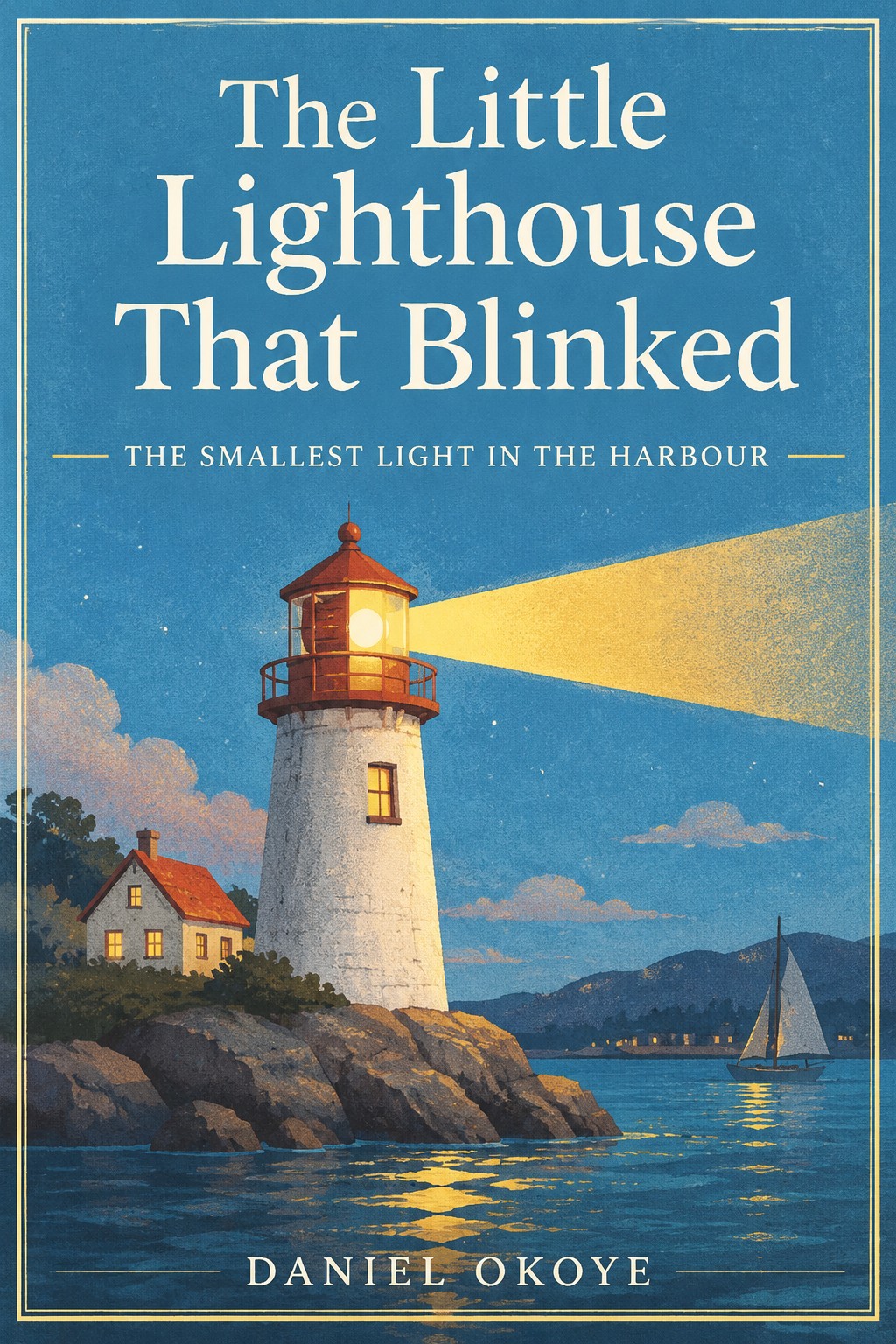
The Little Lighthouse That Blinked
The smallest light in the harbour
by Daniel Okoye
The big lighthouse shows the way to the sea. The little lighthouse blinks at the harbour mouth and does not think it matters. Then the fog comes in.
How this one was built
Built from the children’s template. The lighthouse’s blink count was held as a key fact, one blink per section.
Sample only — the manuscript is not for sale. The plan is free to copy.
Read the first section
The opening, in full. About 2 min. Turn the pages with the arrows, your keyboard, or a swipe.
Chapter 1
The night the fog came in
There were two lighthouses in the harbour.
The big lighthouse stood on the cliff and turned its lamp all the way round, so that every boat, everywhere at sea, could see the way home. It had been doing this for a hundred years. It was very good at its job.
The little lighthouse stood at the harbour mouth. It was small and round and painted white with a red stripe. Its light was not very bright. It did not turn all the way round. It only blinked.
Blink. Pause. Blink.
Most nights, nobody noticed the little lighthouse at all.
"Why do you even have a light?" asked a passing seagull.
"To show the harbour mouth," said the little lighthouse.
"The harbour mouth is right there," said the seagull. "It is very obvious."
"Not in the fog," said the little lighthouse. "In the fog, you cannot see the mouth at all."
What's inside
1 sections · 340 wordsEvery section in the book, with the one-line recap it is written against. The first is free above; the rest arrive as empty pages when you copy the plan, and cost 3 credits each to write.
- 01
The night the fog came in
The big light goes out and the little lighthouse must do the job it was sure nobody needed.
Who it is for
For readers of three to seven, and anyone who has ever felt too small for the job.
What you end up with
A complete picture-book plan: the fog, the big light going out, and one small blink that gets a boat home.
Build mine from this
Plan free · 1 credits to write the sectionsYou get the same 1 sections, in the same order, with the same recaps — and an empty page under each one. Change the title and the angle, then write it in your own words.
Or start with your own idea
Pick the type, write the premise, and the plan gets generated for your topic instead. Export it as EPUB when it is done.