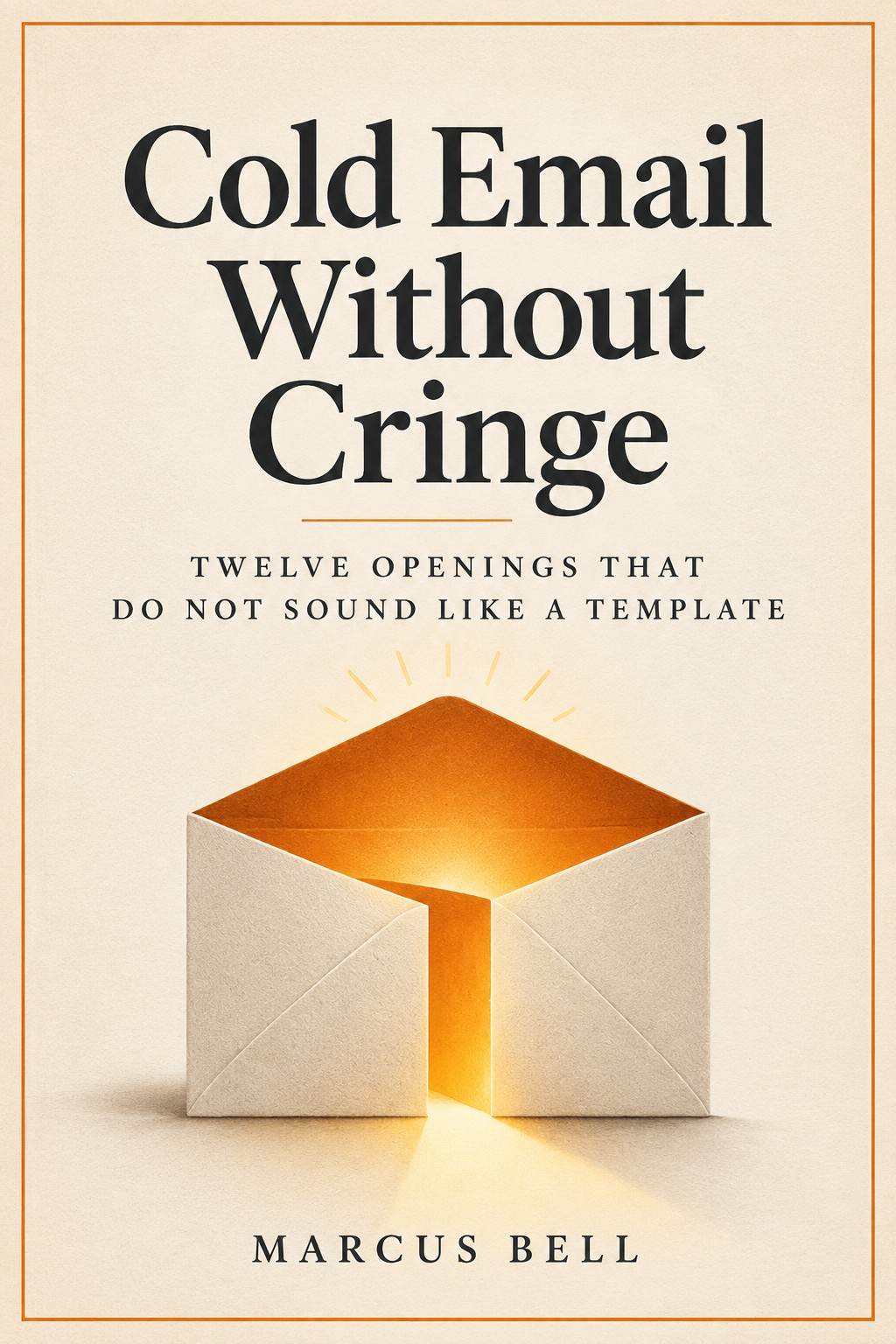
Cold Email Without Cringe
Twelve openings that do not sound like a template
by Marcus Bell
A short guide to writing emails people answer, built on one rule: prove you looked before you ask. Twelve openings, four follow-ups, and a system for sending twenty a week without becoming a spammer.
How this one was built
Built from the guide template: the twelve openings were held as key facts, one per example, so the prose could not invent a thirteenth.
Sample only — the manuscript is not for sale. The plan is free to copy.
Read the first chapter
The opening, in full. About 2 min. Turn the pages with the arrows, your keyboard, or a swipe.
Chapter 1
The first line does all the work
People decide whether to read a cold email in the first eight words, and they decide it with the same instinct they use to spot a leaflet under the windscreen wiper. The instinct is looking for evidence that the sender has not looked at the recipient at all. "I hope this finds you well" is evidence. So is "I came across your company".
A first line that survives the instinct has to be specific to the person and irrelevant to your offer. It should show that you noticed something real: a talk they gave, a page they published, a detail in their product that only someone who used it would know. The goal is not flattery. It is proof of attention.
What's inside
1 chapters · 351 wordsEvery chapter in the book, with the one-line recap it is written against. The first is free above; the rest arrive as empty pages when you copy the plan, and cost 3 credits each to write.
Chapter 1 — The first line does all the work
Write a line that could only have been sent to this one person, then delete everything that sounds like a pitch.
Who it is for
For founders and freelancers who need conversations with strangers and would rather do almost anything else.
What you end up with
A twenty-email weekly rhythm, twelve opening lines that work, and a follow-up that does not feel like a chase.
Build mine from this
Plan free · 1 credits to write the chaptersYou get the same 1 chapters, in the same order, with the same recaps — and an empty page under each one. Change the title and the angle, then write it in your own words.
Or start with your own idea
Pick the type, write the premise, and the plan gets generated for your topic instead. Export it as EPUB when it is done.